

Choosing between 3000K and 4000K LED strip lights comes down to the appearance you want, the surfaces you are lighting and how the space is used. A 3000K strip gives a warmer white tone; a 4000K strip looks cooler and more neutral by comparison. Neither is automatically the right choice for every kitchen, shelf or commercial display.
This guide helps you compare the two before ordering LED strip lighting for an Australian home or business.
3000K vs 4000K: a quick comparison
| What to compare | 3000K LED strip lights | 4000K LED strip lights |
|---|---|---|
| White-light appearance | Warmer, with a more yellow-white tone | Cooler white relative to 3000K |
| Design starting point | Living areas and decorative joinery | Worktops and displays with a cooler look |
| What to check in the room | Whether the warmth suits your finishes and nearby lights | Whether the cooler tone suits your finishes and nearby lights |
| Brightness | Check the stated lumens per metre | Check the stated lumens per metre |
What do 3000K and 4000K mean?
The K stands for kelvin, the unit used for correlated colour temperature, or CCT. It describes the shade of white light. A lower number indicates a warmer-looking tone, while a higher number indicates a cooler-looking tone. It does not describe the temperature of the strip when it is operating.
Product descriptions may call 4000K neutral white or cool white. Compare the numerical Kelvin rating rather than relying only on those names. Our colour-temperature explainer covers the broader scale.
Which is better for kitchen under-cabinet lighting?
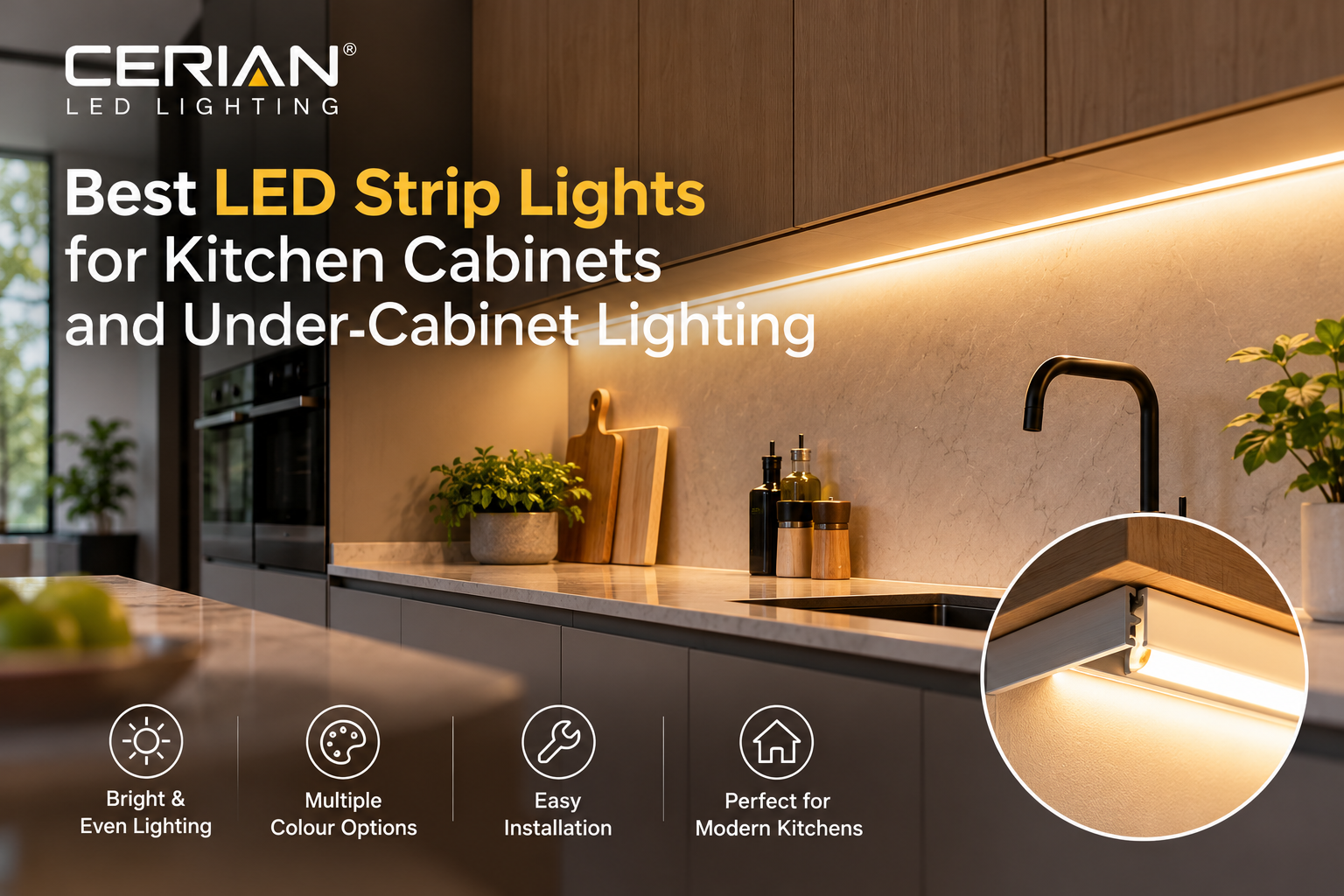
Start with the rest of the kitchen. If the downlights and pendants are warm white, a 3000K strip may give the joinery a more consistent appearance. If you prefer a cooler-looking work surface, consider 4000K and compare it with the existing lighting before making a final choice.
Test a short sample against the actual splashback, benchtop and cupboard finish. Look at it during the day and after dark: reflected light and surrounding finishes affect how the result looks. The position of the strip also matters, particularly where a glossy benchtop can reflect the light source.
For placement and component planning, see our kitchen cabinet and under-cabinet lighting guide.
Is 4000K brighter than 3000K?
The Kelvin rating alone does not tell you which strip produces more light. Compare the lumens per metre for the exact models, then consider the length being installed and how the light will reach the surface. Watts per metre describes power consumption, so it is not a substitute for checking light output.
For example, if two strips are both described as 10W per metre, that does not establish that their lumen output is identical. Check both datasheets. A diffuser and the mounting arrangement can also change how much light reaches the area you want to illuminate.
Choosing a colour temperature for shelves and displays
For a timber bookcase or a decorative niche, try 3000K as a starting point if you want a warmer appearance. For a work shelf or merchandise display, compare 4000K if you prefer a cooler white. These are design choices rather than rules: assess the light on the objects and materials that will actually be displayed.
Also check colour rendering. CCT describes the white-light tone; the colour-rendering index, or CRI, describes a different aspect of light quality. A 4000K strip is not automatically more colour-accurate than a 3000K strip. Compare the specifications when the appearance of products, fabrics or finishes matters.
Match the strip, profile, driver and controls
- Confirm the voltage: match the strip with the specified driver output and driver type.
- Check the installed load: use the strip’s watts per metre and connected length when selecting driver capacity.
- Plan the mounting: choose a suitable aluminium extrusion profile and check the strip manufacturer’s mounting requirements.
- Check dimming: confirm compatibility across the strip, driver and controller. Ordinary dimming does not necessarily change colour temperature.
- Check the environment: choose an appropriate IP rating for the actual location and the completed installation.
Our 24V LED driver selection guide explains the power-supply checks in more detail.
Frequently asked questions
Can I mix 3000K and 4000K in one room?
You can use different colour temperatures for separate lighting zones, but the difference may be obvious where the light overlaps. Compare samples together if a consistent appearance is important.
Does a dimmer turn 4000K into 3000K?
A standard dimmable fixed-white strip does not necessarily offer that function. To adjust the shade of white, choose a suitable tunable-white system with compatible controls, or a product explicitly specified for dim-to-warm operation.
Which should I choose if I am unsure?
Match your existing lights as a starting point, then test samples beside your finishes. If both shades are needed at different times, ask about a compatible CCT-adjustable strip and controller.
Compare LED strip lights at Empire of Light
Browse our LED strip lights and compare colour temperature, light output, voltage, dimensions and IP rating for the exact product. Tell our team your intended location, run length and preferred controls so we can help you narrow the options.
Further reading: Australian Government Energy Rating: choosing the right lamp and Your Home: lighting.