


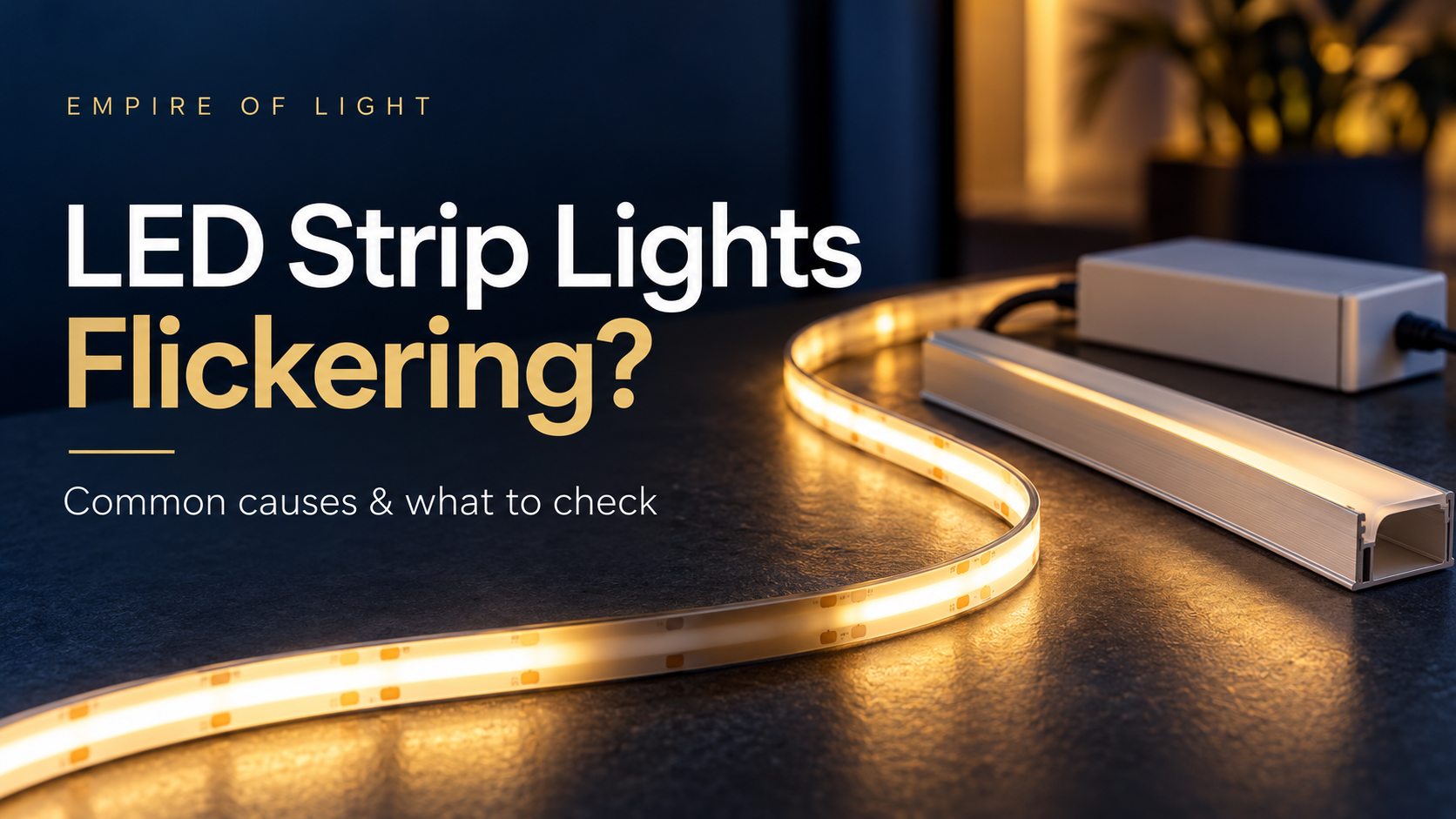
Why Are My LED Strip Lights Flickering? Causes and Checks
LED strip lights flickering can point to a mismatch between the strip, driver and dimmer, an overloaded component or a poor connection. Before replacing the strip, note when the problem happens: only while dimming, across the whole run, at one join or after the lights have warmed up. That pattern helps narrow the checks.
Safety first: Switch the lights off before inspecting accessible low-voltage connections. Do not open a driver or work on mains wiring. Have a licensed electrician investigate hardwired equipment, damaged cables, burning smells or repeated tripping.
Quick guide: match the symptom to the check
| What you notice | What to check |
|---|---|
| Flickering only at low brightness | Driver and dimmer compatibility, supported dimming range and minimum load. |
| The whole strip flashes or repeatedly switches off | Driver voltage, total connected load and protection behaviour. |
| One section flickers near a join | Connector fit, strip width, contact alignment and signs of damage. |
| The far end is dimmer | Run length and voltage drop; uneven brightness is not always flicker. |
| The problem starts after warm-up | Driver ventilation, mounting conditions and temperature limits. |
1. Check the dimming system first
If the strip is stable at full brightness but flickers when dimmed, record the dimmer, driver and controller model numbers. A driver marked “dimmable” still needs the correct control method: phase-cut, 0–10V, DALI and low-voltage PWM are different systems. Check the manufacturer's compatibility information and supported load range.
Ask your installer whether the combination supports the brightness level you want. Raising the setting can help identify a low-end problem, but it does not establish that the installation is correctly matched. Browse LED smart controllers and confirm compatibility before ordering.
2. Match voltage and calculate the connected load
Read the strip's voltage and watts-per-metre specification. A 24V constant-voltage strip needs a compatible 24V constant-voltage supply; a larger wattage rating does not make a different voltage suitable.
For example, 5 metres of strip rated at 10W per metre has a nominal strip load of 50W. Include every connected run, controller requirements and the manufacturer's temperature derating and loading instructions when selecting equipment. Do not assume one spare-capacity percentage suits every driver. Our 24V LED driver guide explains the selection process; compare specifications in our LED driver range.
3. Inspect accessible connectors with power off
A loose or unsuitable connector is worth checking when the problem affects one joint or section. Check the connector's stated strip width, pin count and current rating against the strip. Water-resistant coatings can also affect which connector is suitable. Stop using damaged or heat-discoloured parts and ask an installer to assess them.
See our LED strip connectors versus soldering guide before choosing a connection method.
4. Separate voltage drop from flickering
A consistently dimmer far end needs a different investigation from a whole strip that flashes. Give your installer the strip length, watts per metre and cable distance from the driver. Follow the strip manufacturer's maximum run length and have the cable and feed arrangement checked. Do not turn up a power supply's output voltage to compensate without explicit manufacturer guidance.
5. Check heat and mounting conditions
Tell your installer if flickering begins only after the lights have been on for a while. Driver protection and installation conditions need checking against the actual product instructions. Keep ventilation openings unobstructed and use the specified mounting method. Our COB strip and aluminium profile guide covers mounting considerations.
Questions about flickering LED strip lights
Will buying a bigger driver fix flickering?
Only if insufficient capacity is the cause and the replacement also matches the voltage, control method and installation requirements. Compatibility and load limits still matter.
Can COB LED strip lights flicker?
COB describes the strip construction. It does not guarantee that every driver and controller combination will dim smoothly. Check the complete system.
Why do the lights look steady but show bands on my phone?
A camera can reveal modulation that is less obvious to the eye. Recording settings and the lighting's dimming method can both affect the result. If the space is used for filming, ask for suitability at the intended brightness and test the actual combination.
Get help choosing compatible components
Contact Empire of Light with the strip voltage, watts per metre, total length, driver and controller model numbers, and when the flicker occurs. We can help compare product specifications before you buy. Explore our LED strip lights for replacement or new projects; electrical fault diagnosis and mains work should be handled by a licensed electrician.
Technical background: MEAN WELL's LED strip dimming guidance and LED power supply application FAQs. Always follow the instructions for your specific products.
3000K vs 4000K LED Strip Lights: Which Should You Choose?
Choosing between 3000K and 4000K LED strip lights comes down to the appearance you want, the surfaces you are lighting and how the space is used. A 3000K strip gives a warmer white tone; a 4000K strip looks cooler and more neutral by comparison. Neither is automatically the right choice for every kitchen, shelf or commercial display.
This guide helps you compare the two before ordering LED strip lighting for an Australian home or business.
3000K vs 4000K: a quick comparison
| What to compare | 3000K LED strip lights | 4000K LED strip lights |
|---|---|---|
| White-light appearance | Warmer, with a more yellow-white tone | Cooler white relative to 3000K |
| Design starting point | Living areas and decorative joinery | Worktops and displays with a cooler look |
| What to check in the room | Whether the warmth suits your finishes and nearby lights | Whether the cooler tone suits your finishes and nearby lights |
| Brightness | Check the stated lumens per metre | Check the stated lumens per metre |
What do 3000K and 4000K mean?
The K stands for kelvin, the unit used for correlated colour temperature, or CCT. It describes the shade of white light. A lower number indicates a warmer-looking tone, while a higher number indicates a cooler-looking tone. It does not describe the temperature of the strip when it is operating.
Product descriptions may call 4000K neutral white or cool white. Compare the numerical Kelvin rating rather than relying only on those names. Our colour-temperature explainer covers the broader scale.
Which is better for kitchen under-cabinet lighting?
Start with the rest of the kitchen. If the downlights and pendants are warm white, a 3000K strip may give the joinery a more consistent appearance. If you prefer a cooler-looking work surface, consider 4000K and compare it with the existing lighting before making a final choice.
Test a short sample against the actual splashback, benchtop and cupboard finish. Look at it during the day and after dark: reflected light and surrounding finishes affect how the result looks. The position of the strip also matters, particularly where a glossy benchtop can reflect the light source.
For placement and component planning, see our kitchen cabinet and under-cabinet lighting guide.
Is 4000K brighter than 3000K?
The Kelvin rating alone does not tell you which strip produces more light. Compare the lumens per metre for the exact models, then consider the length being installed and how the light will reach the surface. Watts per metre describes power consumption, so it is not a substitute for checking light output.
For example, if two strips are both described as 10W per metre, that does not establish that their lumen output is identical. Check both datasheets. A diffuser and the mounting arrangement can also change how much light reaches the area you want to illuminate.
Choosing a colour temperature for shelves and displays
For a timber bookcase or a decorative niche, try 3000K as a starting point if you want a warmer appearance. For a work shelf or merchandise display, compare 4000K if you prefer a cooler white. These are design choices rather than rules: assess the light on the objects and materials that will actually be displayed.
Also check colour rendering. CCT describes the white-light tone; the colour-rendering index, or CRI, describes a different aspect of light quality. A 4000K strip is not automatically more colour-accurate than a 3000K strip. Compare the specifications when the appearance of products, fabrics or finishes matters.
Match the strip, profile, driver and controls
- Confirm the voltage: match the strip with the specified driver output and driver type.
- Check the installed load: use the strip's watts per metre and connected length when selecting driver capacity.
- Plan the mounting: choose a suitable aluminium extrusion profile and check the strip manufacturer's mounting requirements.
- Check dimming: confirm compatibility across the strip, driver and controller. Ordinary dimming does not necessarily change colour temperature.
- Check the environment: choose an appropriate IP rating for the actual location and the completed installation.
Our 24V LED driver selection guide explains the power-supply checks in more detail.
Frequently asked questions
Can I mix 3000K and 4000K in one room?
You can use different colour temperatures for separate lighting zones, but the difference may be obvious where the light overlaps. Compare samples together if a consistent appearance is important.
Does a dimmer turn 4000K into 3000K?
A standard dimmable fixed-white strip does not necessarily offer that function. To adjust the shade of white, choose a suitable tunable-white system with compatible controls, or a product explicitly specified for dim-to-warm operation.
Which should I choose if I am unsure?
Match your existing lights as a starting point, then test samples beside your finishes. If both shades are needed at different times, ask about a compatible CCT-adjustable strip and controller.
Compare LED strip lights at Empire of Light
Browse our LED strip lights and compare colour temperature, light output, voltage, dimensions and IP rating for the exact product. Tell our team your intended location, run length and preferred controls so we can help you narrow the options.
Further reading: Australian Government Energy Rating: choosing the right lamp and Your Home: lighting.
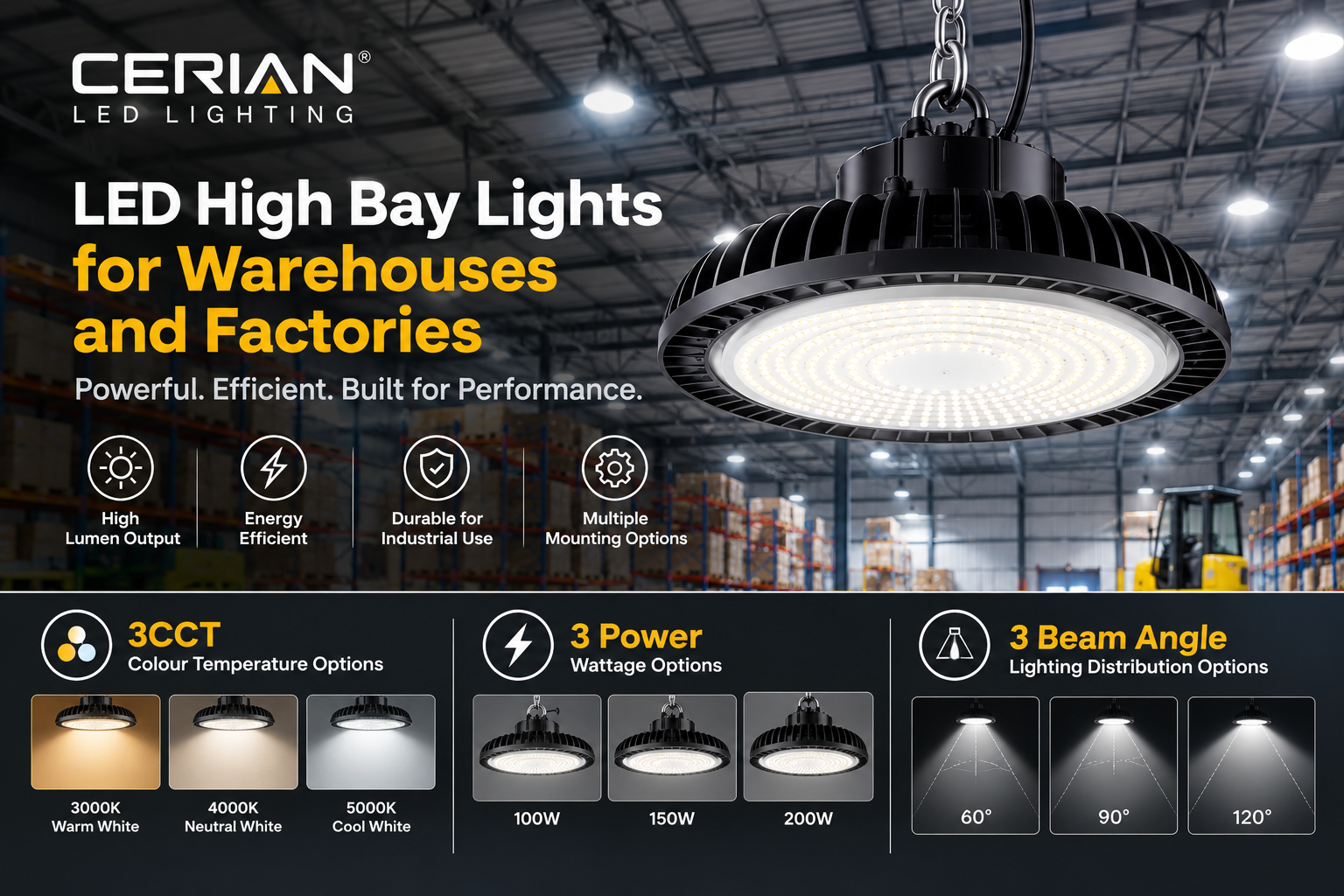
How to Choose LED High Bay Lights for Warehouses and Factories
What is an LED high bay light?
LED high bay luminaires are designed to illuminate spaces with relatively high ceilings, such as warehouses, manufacturing facilities, workshops and logistics centres. Different fittings use different optical distributions and mounting systems. Suitability must be determined from the actual luminaire datasheet and the project's lighting design.1. Start with the space and mounting height
Record the ceiling height, intended mounting height, floor area, racking positions, workstations and any obstructions. A fitting suitable for a wide open storage area may not be appropriate between tall warehouse racks. Mounting height influences the light distribution and spacing required for even coverage.2. Compare lumens, not watts alone
Wattage indicates electrical power consumption, while lumens indicate the light output of the fitting. Two high bays with the same wattage can deliver different lumen outputs and optical performance. Compare manufacturer-rated lumens, luminaire efficacy in lumens per watt (lm/W), beam distribution and any relevant photometric files. Example: A hypothetical 150W luminaire rated at 150 lm/W would deliver approximately 22,500 lumens. This is a calculation example, not a verified specification for any particular CERIAN product.3. Choose an appropriate beam angle
Narrower beam distributions can concentrate light over a smaller area; wider distributions can spread light more broadly. The correct selection depends on mounting height, fixture spacing, aisle width, rack height and required uniformity. A lighting calculation using the manufacturer's photometric data is more reliable than choosing beam angle from a simple height chart.4. Plan the required illuminance
Different tasks require different lighting conditions. General storage, order picking, packing, machinery operation and detailed inspection should not automatically use the same lighting design. Consider task illuminance, uniformity, glare, vertical illumination and applicable workplace lighting requirements. An appropriately qualified lighting designer can check the design against relevant Australian standards and project requirements.5. Select colour temperature and colour rendering
Neutral or cool white lighting is often considered for industrial spaces, but the correct colour temperature depends on the work environment and existing lighting. Colour rendering can be important where workers distinguish product labels, wire colours or material finishes. Review the documented CCT and CRI rather than assuming all high bays offer the same options.6. Check glare and visual comfort
High output does not automatically mean good visibility. Excessive glare, harsh reflections and uneven lighting can make work more difficult. Consider mounting position, optical control and the viewing direction of forklift operators and other staff.7. Review the operating environment
Factories and warehouses may expose luminaires to dust, moisture, elevated temperatures, vibration or cleaning processes. Check the specific luminaire's ingress protection, ambient operating temperature, mounting requirements and any applicable impact resistance. For food processing or specialist environments, additional product suitability requirements may apply.8. Consider controls and energy use
Occupancy sensors, daylight controls and scheduled switching may help reduce operating hours where suitable. Confirm the driver and luminaire support the proposed control method. A dimmable luminaire should not be assumed compatible with every dimming system. For a simple energy estimate, a 150W fitting operating 10 hours a day consumes 1.5 kWh per day before accounting for control strategies. Multiply the number of fittings and operating days to estimate site consumption. Actual savings depend on the existing installation, new fitting performance and usage.9. Check installation and maintenance access
Verify mounting hardware, suspension height, cable routing, emergency lighting interactions and access for future maintenance. Electrical installation in Australia must be undertaken by appropriately licensed professionals in accordance with applicable requirements. Confirm product documentation, warranties and any relevant compliance information before ordering.LED high bay selection checklist
- Measure mounting height, floor dimensions and racking layout.
- Identify tasks and target lighting conditions.
- Compare verified lumen output, efficacy and photometric distribution.
- Check CCT, CRI, glare and uniformity.
- Confirm environmental ratings and operating temperatures.
- Review controls, electrical compatibility and maintenance access.
- Obtain a lighting calculation for larger or complex projects.
Frequently asked questions
Is a 150W LED high bay suitable for every warehouse?
No. Wattage alone cannot establish suitability. Mounting height, output, optics, fixture spacing and required lighting levels all matter.How many LED high bay lights do I need?
The number depends on the room dimensions, mounting height, required illuminance, luminaire photometry, reflectances and obstructions. Use a lighting design rather than estimating from wattage alone.Are LED high bays suitable for factories?
Many are designed for industrial applications, but check the exact product's temperature limits, ingress protection, optics and any task-specific requirements.Can high bay lights be dimmed or connected to sensors?
Some models support compatible controls. Check the actual driver's capabilities and the specified control interface before installation.Explore commercial LED lighting at Empire of Light
Empire of Light supplies lighting products for commercial and industrial projects in Australia. Browse the Empire of Light website for the current CERIAN range and request product-specific technical information when planning a warehouse or factory installation. For other commercial lighting applications, read our retail and commercial display lighting guide.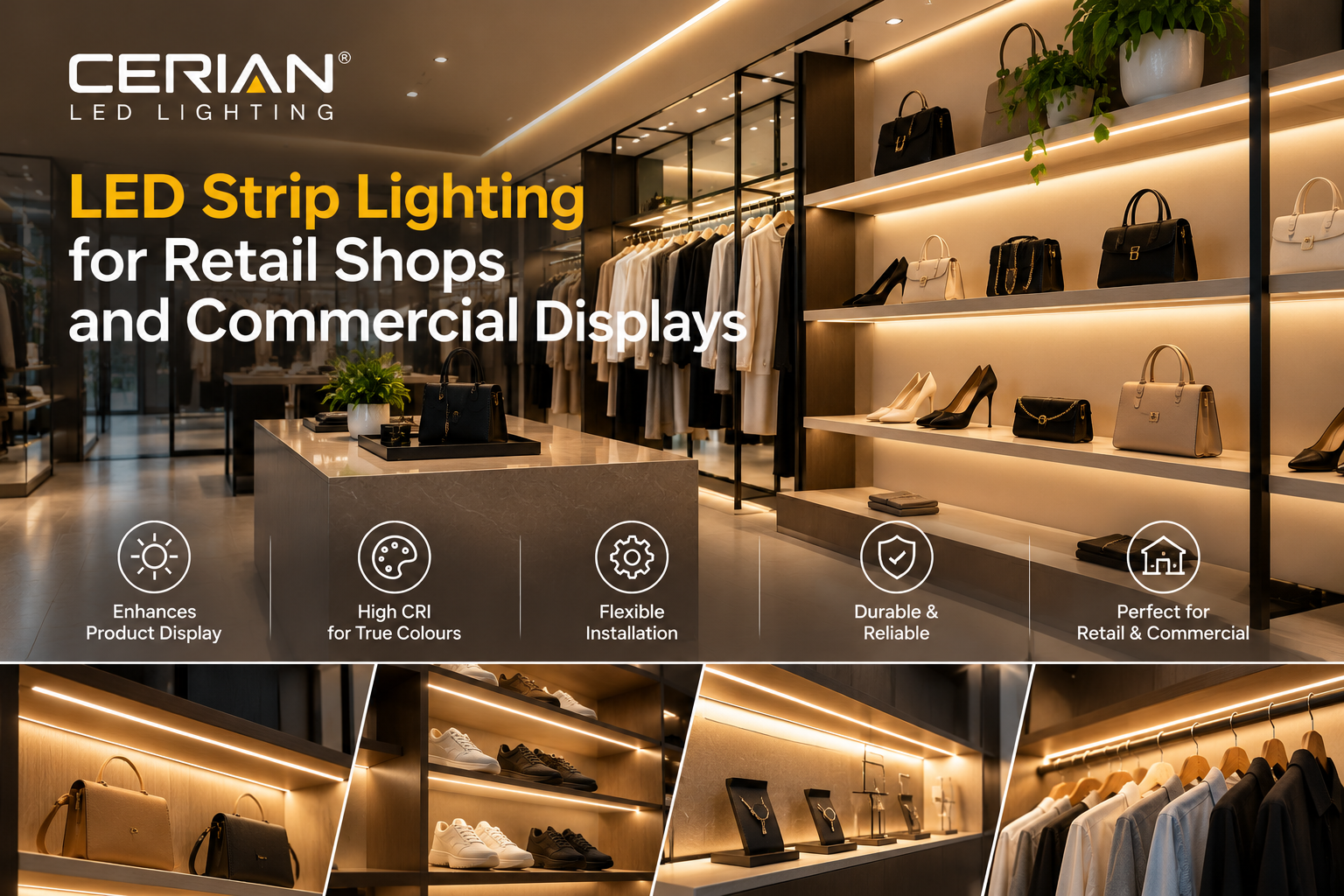
LED Strip Lighting for Retail Shops and Commercial Displays
Where LED strip lighting works in retail stores
Product shelves and display cabinets
Concealed LED strips can illuminate merchandise on shelves and inside cabinets. Position them to minimise shadows and avoid direct glare into customers' eyes. For reflective products such as glassware and jewellery, test the placement to control unwanted reflections.Shopfronts and window displays
Linear lighting can define window frames, plinths and display edges. Consider daylight competition, viewing angles and operating hours. The right brightness depends on the display design rather than a fixed wattage target.Countertops and point-of-sale areas
Under-counter or integrated joinery lighting can help create visual separation and support wayfinding. Keep electrical components accessible for maintenance and avoid placing exposed strips where they can be struck or cleaned with water.Architectural features
LED profiles can highlight coves, wall details and feature ceilings. Coordinate the lighting layout with the shopfitter before cabinetry and plaster finishes are finalised.COB LED strips or conventional LED strips?
COB LED strips can create a smoother-looking continuous line, making them attractive for visible architectural details and shallow profiles. Conventional LED strips may be suitable for concealed shelving or other applications where individual LED points are not visible. Compare actual lumen output, colour rendering, power, dimensions and manufacturer installation requirements instead of choosing by technology alone.Choose the right colour temperature
Warm white lighting around 2700K–3000K can create an inviting atmosphere in some hospitality-inspired or premium retail interiors. Neutral white around 3500K–4000K can suit many general retail environments. Cooler white may be appropriate for selected applications. Consistency across nearby displays is often more important than choosing a single colour temperature for every store. Colour rendering matters for clothing, cosmetics, furniture and food displays. Check the product's documented CRI and, where relevant, more detailed colour-quality data before specification. A higher CRI can help colours appear more natural, but lighting design also depends on spectrum, illumination levels and surrounding finishes.Plan brightness and glare control
Compare lumen output and lighting distribution, not just watts per metre. An overly bright exposed strip can cause uncomfortable glare and reduce the visual quality of the display. Recessed mounting, suitable diffusers and thoughtful positioning can improve comfort. For larger fit-outs, a lighting designer can help verify target illuminance and uniformity.Use aluminium LED profiles for a professional finish
Aluminium profiles can conceal the strip, support mounting and provide a tidy architectural detail. Choose surface-mounted, recessed or corner profiles based on the joinery. Verify the profile's usable internal dimensions and compatibility with the selected strip and diffuser. See our COB LED strip aluminium profile installation guide.Calculate LED driver capacity correctly
Multiply strip power per metre by the installed length to calculate the nominal connected load. For example, a 6m installation using a strip rated at 12W/m has a nominal load of 72W. The example is illustrative; use the exact product datasheet. Select a driver with matching output voltage, sufficient capacity and an appropriate operating margin, following the manufacturer's requirements. Browse CERIAN LED drivers and read how to choose a 24V LED driver. Long runs may require multiple feeds or a different layout to manage voltage drop.Consider dimming and lighting controls
Retail displays may need different lighting scenes for daytime, evening or special promotions. Dimming and controls can support this flexibility, but compatibility must be checked across the strip, driver and controller. Do not assume every LED driver supports mains dimming or every strip supports the same control protocol.Indoor, outdoor and shopfront protection ratings
Dry indoor shelving may use appropriately specified IP20 products. Exposed shopfronts and damp areas need components rated for actual conditions, including drivers, connectors and terminations. IP67 is not a blanket approval for permanent underwater use. Read our IP20 vs IP67 vs IP68 LED strip guide before selecting protection ratings.Installation and maintenance checklist
- Confirm strip width, voltage, wattage, lumen output and colour specifications.
- Choose a compatible profile, diffuser and connector system.
- Plan power supply locations and access for servicing.
- Check maximum run length, voltage drop and heat management.
- Test sample lighting against real merchandise and store finishes.
- Document the final driver and controller layout for future maintenance.
Frequently asked questions
Are COB LED strips suitable for retail display shelves?
They can be, particularly where a smooth line of light is desirable. Confirm brightness, colour quality, profile fit and thermal requirements for the specific display.What colour temperature is best for a clothing store?
It depends on the brand atmosphere, merchandise and surrounding light. Many retailers compare warm and neutral white samples before final selection. Good colour rendering is especially important when customers assess fabric colours.Can one driver power multiple display shelves?
Potentially, provided the combined load, wiring, voltage drop and driver specifications allow it. Consider maintenance access and how individual shelves will be controlled.Should LED strips be installed with connectors or soldering?
Both can work where approved by the manufacturer. Read our LED strip connectors vs soldering comparison for compatibility and reliability considerations.Explore commercial LED lighting at Empire of Light
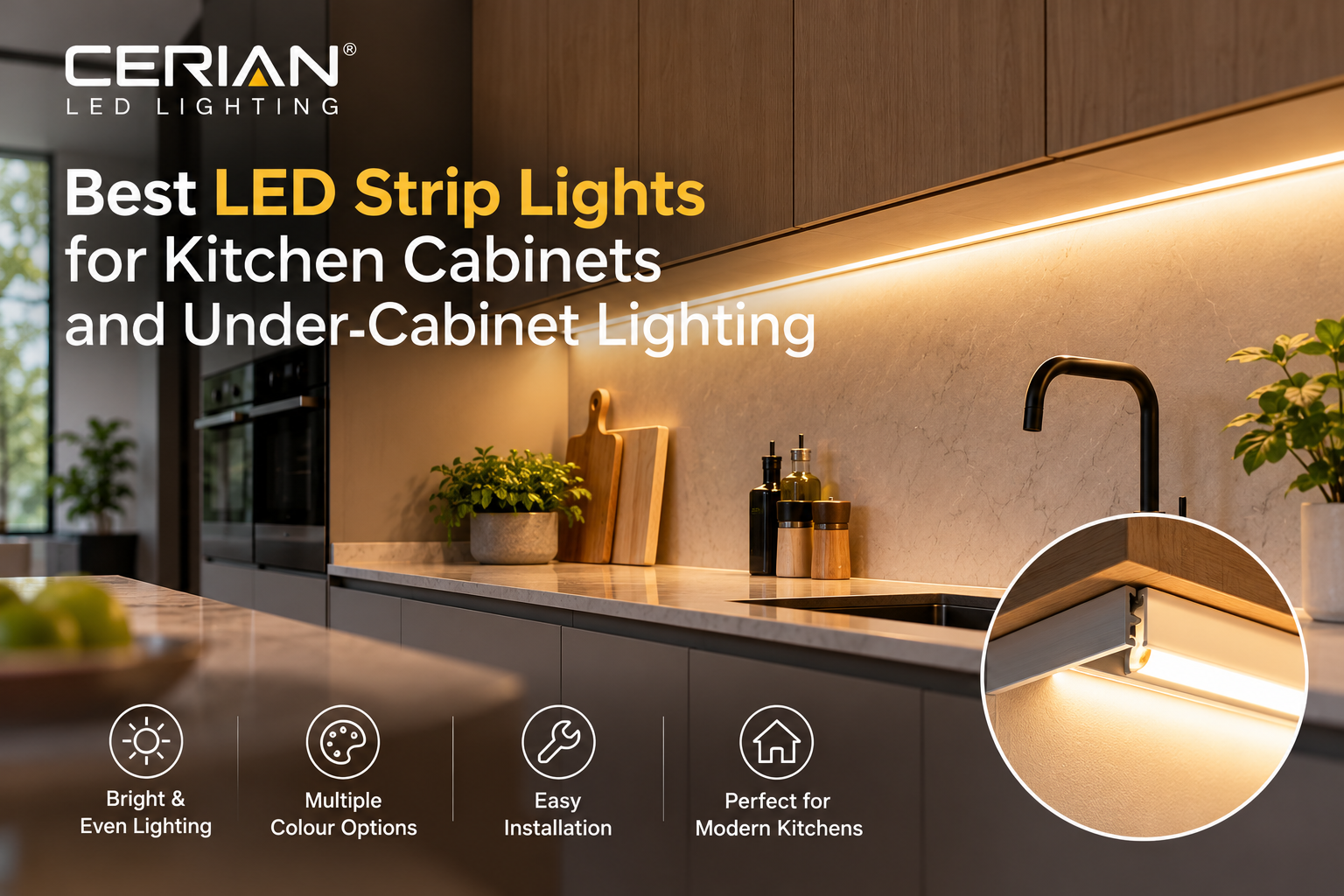
Empire of Light supplies CERIAN lighting products for retail and commercial projects in Australia. Explore LED strip lights and LED drivers and power supplies. Review current product specifications and consult your installer before finalising a commercial fit-out.Best LED Strip Lights for Kitchen Cabinets and Under-Cabinet Lighting
Why choose LED strip lights for kitchen cabinets?
LED strips fit into narrow spaces beneath wall cabinets, inside pantry shelves and along kitchen joinery. When correctly positioned, they can light the work surface without relying entirely on overhead downlights. A suitable aluminium profile and diffuser can help achieve a neat finish and reduce direct views of the light source.COB LED strip lights vs traditional LED strips
COB LED strips use a dense arrangement of light-emitting components and can create a smoother-looking line of light, especially in shallow installations. Traditional LED strips may show individual points of light when viewed directly or through a thin diffuser, although the result depends on LED spacing and profile design. Both types can work well for kitchen lighting when matched to the application. For a clean under-cabinet appearance, consider a compatible COB strip with an aluminium profile. Read our COB LED strip installation guide for profile and diffuser planning.What colour temperature is best for kitchen under-cabinet lighting?
- 2700K–3000K warm white: creates a warm, inviting look that works well with timber and warm-toned finishes.
- 3500K–4000K neutral white: often suits task lighting on kitchen worktops where a balanced appearance is preferred.
- 5000K and above: provides a cooler appearance that may be suitable for some workspaces but can feel stark in residential kitchens.
Comparing warm and cooler white options? Read our 3000K vs 4000K LED strip lights guide for a side-by-side comparison and advice on matching your kitchen finishes.
How bright should kitchen LED strip lights be?
There is no single ideal wattage for every kitchen. Brightness depends on the strip's actual lumen output, cabinet height, mounting position, diffuser and the amount of ambient light. Compare lumens per metre rather than using watts alone as a measure of brightness. For food preparation, prioritise useful illumination across the worktop and avoid glare reflected from glossy splashbacks.Where should you position the strip?
For many kitchens, placing the strip towards the front underside of a wall cabinet helps distribute light across the worktop and reduce shadows cast by the person working. The exact position depends on cabinet depth, splashback finish and the selected profile. Test the light position before permanently fixing the channel.Do kitchen LED strips need aluminium profiles?
An aluminium profile can give a professional finish, protect the strip from incidental contact and assist heat management where the manufacturer specifies it. Recessed and surface-mounted channels are common options. Check the usable internal width, diffuser clearance and mounting method before ordering. The profile and strip must be compatible.Choosing a 24V LED driver for kitchen cabinets
Many LED strips use a 24V DC constant-voltage power supply, but always check the exact strip specifications. Calculate the connected load by multiplying the rated watts per metre by the total installed length, then choose a compatible driver with an appropriate operating margin in line with the manufacturer's instructions. For example, 3 metres of a strip rated at 10W/m has a nominal 30W load. This is an illustrative calculation, not a product recommendation. Read How to Choose a 24V LED Driver and explore CERIAN LED drivers.Should under-cabinet LED strips be dimmable?
Dimming can make the same lighting useful for both food preparation and softer evening ambience. Check whether the strip, controller and driver support the intended dimming method. A standard non-dimmable driver should not be assumed compatible with a wall dimmer. Some systems use a compatible low-voltage controller between the driver and strip.What IP rating is suitable for a kitchen?
IP20 LED strips may be appropriate for dry, protected locations. Areas exposed to splashes, moisture or frequent cleaning may need additional protection. Select components based on the actual exposure, including connectors and cable terminations. See our IP20 vs IP67 vs IP68 LED strip comparison for more guidance.Kitchen cabinet lighting ideas
Under wall cabinets
Install a continuous strip beneath overhead cabinets to illuminate chopping boards, preparation areas and the splashback.Inside pantry and display cabinets
Use appropriately positioned LED strips to illuminate shelves and help locate items. Consider glare, door clearance and suitable switching or sensors.Kitchen island and toe-kick lighting
Concealed strips can create a subtle floating effect under a kitchen island or along the base of cabinetry. Check cleaning exposure, impact protection and how the light reflects from the floor.Common mistakes to avoid
- Choosing wattage without checking actual lumen output.
- Installing a bright exposed strip where it creates uncomfortable glare.
- Using a driver with the wrong output voltage or inadequate capacity.
- Ignoring voltage drop on long runs.
- Using connectors that do not match the strip width or pad layout.
- Placing a dry-location strip where it may be exposed to water.
Frequently asked questions
Are COB LED strips good for under-cabinet lighting?
Yes, compatible COB strips can provide a smooth-looking line of light. The final result depends on the strip, diffuser, profile and mounting position.Is warm white or cool white better for a kitchen?
Warm white can create a welcoming atmosphere, while neutral white is often preferred for balanced task lighting. Match the choice to the kitchen finishes and existing lights.Can LED strips be installed directly under wooden cabinets?
Follow the strip manufacturer's approved mounting and thermal instructions. A suitable aluminium profile may be recommended; do not assume adhesive backing alone is sufficient for every installation.Can one driver power several cabinet LED strips?
Potentially, if the combined load, wiring and voltage drop are within the driver's specifications. Check connection layout and manufacturer requirements.Shop LED strip lighting for kitchens in Australia
Explore LED strip lights at Empire of Light and browse LED drivers and power supplies for compatible lighting projects. Confirm each CERIAN product's current specifications, dimensions and installation requirements before purchase.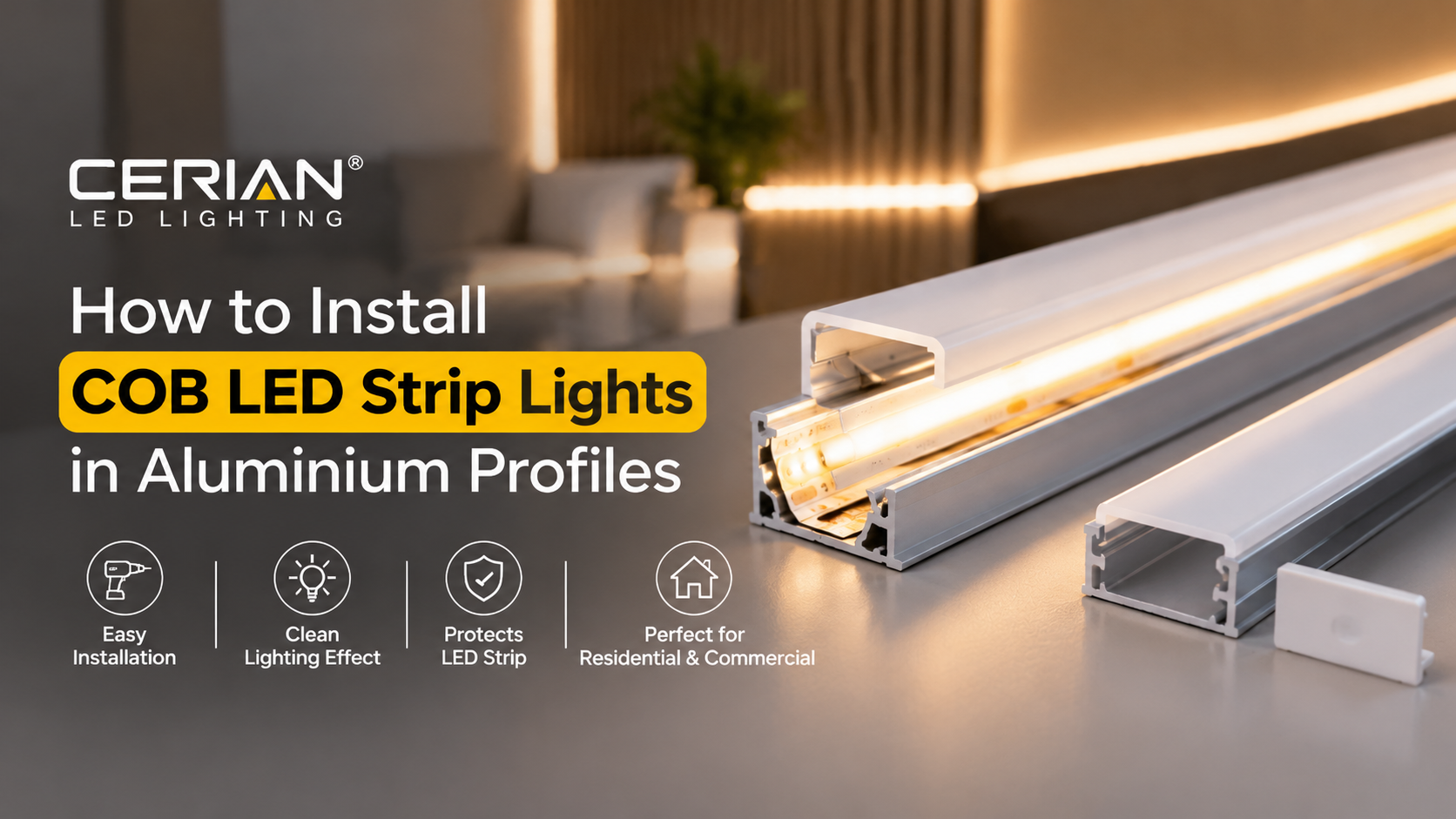
How to Install COB LED Strip Lights in Aluminium Profiles
Why use an aluminium profile with COB LED strips?
An LED aluminium profile, sometimes called an extrusion or channel, provides a defined mounting surface and a neat edge for linear lighting. Many profiles accept a diffuser cover and end caps. Depending on the specific products, the aluminium can also assist heat transfer. Always follow the strip and profile manufacturers' thermal and mounting instructions.1. Choose the right profile type
Common profile styles include surface-mounted, recessed, plaster-in and corner channels. Surface-mounted profiles suit many cabinets and shelves. Recessed profiles can create a flush finish where the substrate allows. Plaster-in profiles require careful coordination with the wall or ceiling finish. Corner profiles can direct light across a worktop or into a display. Check the profile's internal usable width, depth, diffuser clearance, fixing method and accessories. The strip must fit with enough clearance for any coating, connector and cable exit. External profile dimensions alone do not confirm strip compatibility.2. Select a compatible COB LED strip
Before purchasing, check the LED strip's voltage, power per metre, width, cut intervals, IP rating and permitted maximum run length. Match colour temperature and colour-rendering performance to the application. COB strips can look more continuous than some conventional LED tapes, but appearance still depends on the strip, diffuser and viewing distance. Explore Empire of Light's LED strip lighting range for available options.3. Plan the driver and cable route
Calculate total strip load by multiplying watts per metre by installed length. Select a compatible constant-voltage driver with suitable capacity and operating margin, following the product datasheet. Check controller and dimming compatibility, cable sizing, voltage drop and accessibility for future servicing. For a worked example, read How to Choose a 24V LED Driver for LED Strip Lights or browse LED drivers.4. Measure and prepare the installation
- Measure the mounting location and confirm profile lengths, corners and end caps.
- Identify fixing points and ensure the mounting surface is suitable and level.
- Plan where the supply cable enters and where joints will be accessible.
- Cut the aluminium profile using suitable tools and deburr sharp edges, following the manufacturer's instructions.
- Keep dust, swarf and debris away from the LED strip and electrical contacts.
5. Fix the aluminium channel securely
Use the manufacturer's recommended clips, screws or other approved fixing method. Check the substrate and avoid fasteners that could contact or damage the LED strip. If the profile is recessed or plastered in, confirm the finished surface and diffuser access before closing the installation.6. Install the COB strip inside the profile
Disconnect power before handling the strip. Clean and dry the profile's mounting surface as instructed. Apply the strip evenly without stretching, twisting or exceeding its minimum bend radius. If the strip uses an adhesive backing, follow the adhesive and substrate preparation instructions; adhesive alone may not be an approved fixing method for every environment. Cut only at manufacturer-marked positions. Use compatible connectors or manufacturer-approved soldered connections, with suitable insulation and strain relief. Our LED Strip Connectors vs Soldering guide explains the trade-offs.7. Fit the diffuser and end caps
Test the strip before fitting the diffuser. Confirm consistent illumination, polarity, controller operation and absence of unusual heating. Install the diffuser without pinching wires or forcing components. Diffusers can soften the light and hide individual light sources, but their optical transmission and profile depth affect the final result.8. Check temperature, brightness and maintenance access
Run the lighting under normal operating conditions and check that the installation stays within manufacturer temperature limits. Ensure drivers and controllers have appropriate ventilation and service access. For long runs, assess voltage drop and any visible brightness difference between the start and end of the strip.Common installation mistakes
- Buying a profile without checking its usable internal width.
- Choosing a driver by wattage without verifying output voltage and dimming compatibility.
- Cutting a COB strip away from the designated cut marks.
- Sealing or enclosing components without following thermal guidance.
- Assuming a waterproof strip makes the complete channel and connections waterproof.
- Closing the diffuser before testing the full installation.
Indoor and outdoor installations
For kitchens, cabinetry and dry interiors, check whether an indoor-rated strip and profile are appropriate. Outdoor and wet-area installations need components, connections and power supplies rated for actual exposure. Cutting or joining an IP-rated strip can change its protection. See IP20 vs IP67 vs IP68 LED Strip Lights for a comparison.Frequently asked questions
Do COB LED strips need aluminium profiles?
Not every product requires one, but profiles can provide a tidy finish and may assist heat management when specified by the manufacturer. Check the exact strip's installation requirements.Can I use any diffuser with a COB strip?
No. Match the diffuser to the profile and consider optical transmission, fit and manufacturer compatibility.Can I bend COB strips around a corner inside a profile?
Only within the strip's permitted bending direction and radius. For sharp corners, use a suitable joint or compatible corner connection rather than forcing the strip.Can I install COB LED strips myself?
Planning and some low-voltage assembly tasks may be straightforward, but fixed electrical wiring in Australia must be performed by a licensed electrician where required. Follow local regulations and manufacturer instructions.Explore CERIAN LED strip lighting solutions
Empire of Light offers LED strips, drivers and lighting accessories for residential and commercial projects in Australia. Browse the LED strip range and compatible driver categories, then confirm profile dimensions and component compatibility before ordering.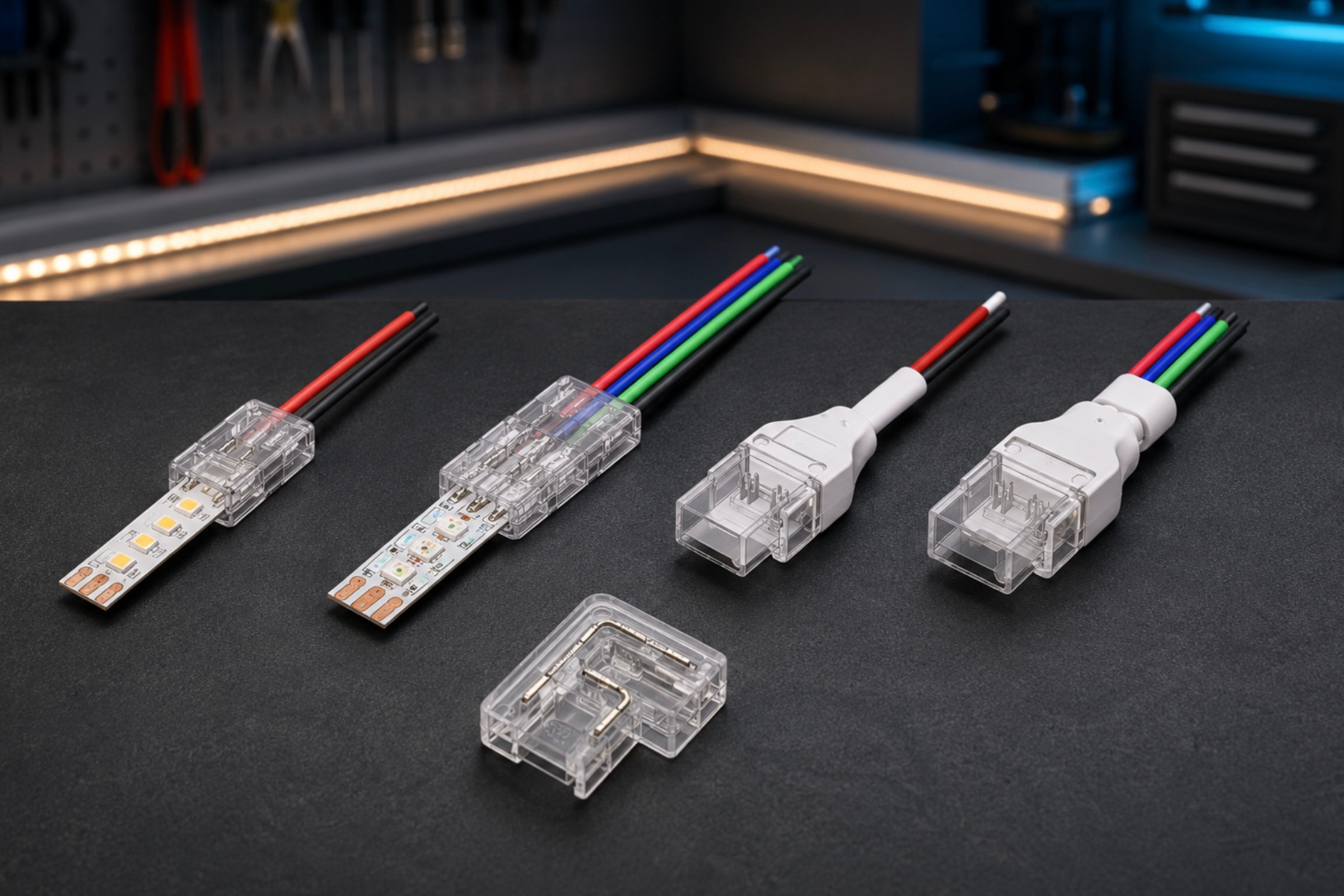
LED Strip Connectors vs Soldering: Which Is Better?
LED strip connectors: how they work
Many LED strip connectors clamp onto designated copper contact pads, allowing a connection without soldering. Options include strip-to-strip, cable-to-strip and corner connectors. Compatibility is critical: match the connector to the strip's width, contact layout, pin count, coating and manufacturer's specifications. COB strips may need connectors designed specifically for COB products.Advantages of solderless connectors
- Fast installation for compatible LED strips.
- Useful for testing, maintenance and some accessible installations.
- Can simplify corners or joins without specialist soldering equipment.
Soldered LED strip connections
Soldering attaches appropriately sized conductors to suitable contact pads. When performed correctly on a strip approved for soldering, it can create a compact connection, particularly in tight profiles. However, soldering requires appropriate tools, technique, strain relief and insulation. Excess heat can damage the strip or pads, and a poorly made joint may fail over time.Connectors vs soldering: comparison
| Factor | Solderless connectors | Soldering |
|---|---|---|
| Installation | Usually faster on compatible strips | Requires tools and soldering skill |
| Physical size | Connector housing may be bulky | Can be compact with suitable insulation |
| Maintenance | Some connectors are removable | Typically requires rework to change |
| Reliability | Depends on fit, contact and environment | Depends on workmanship and strain relief |
| Water protection | Requires verified compatible sealing system | Requires verified restoration of sealing after joining |
Which connector do you need?
2-pin connectors for single-colour strips
Many single-colour LED strips use two electrical contacts, but check the actual strip before selecting a 2-pin connector. Width and pad geometry must also match.4-pin connectors for certain RGB strips
Some RGB strips use four contacts. Other colour-changing systems can use different pin counts or control methods, so do not assume every RGB, RGBW or RGB+CCT strip uses the same connector.COB LED strip connectors
COB strips have dense light-emitting surfaces and may have different cut points or contact arrangements from conventional LED tape. Choose connectors explicitly compatible with the exact COB strip model and width.Corner and cable-to-strip connections
Corner connectors can help route lighting around furniture or cabinetry. Cable-to-strip connectors are useful when the power supply or controller is located away from the strip. Check polarity and conductor capacity for the connected load.Important checks before making a join
- Switch off power: never connect or cut a powered LED strip.
- Check the cut point: cut only where the manufacturer permits.
- Match voltage and contacts: verify 12V/24V compatibility, pin layout, strip width and polarity.
- Check electrical load: ensure the connector and wiring are rated for the expected current.
- Protect the joint: provide strain relief, insulation and suitable environmental sealing.
- Test before closing the profile: check consistent brightness and stable operation.
What about outdoor and waterproof LED strips?
Cutting an IP-rated strip or adding a join may affect the original ingress protection. Follow the strip and connector manufacturers' approved sealing instructions. An IP67 strip or connector alone does not prove the entire assembled system is IP67. For further guidance, read IP20 vs IP67 vs IP68 LED Strip Lights.Do connectors cause voltage drop?
Every connection has some resistance. Poor contact, undersized wiring or excessive run length can contribute to voltage drop, heat or flicker. Follow manufacturer limits and investigate unusual heating or intermittent operation rather than assuming a connector is suitable because it physically fits.Frequently asked questions
Are solderless LED strip connectors reliable?
They can be reliable when approved for the exact strip and installed correctly. Poor fit, incorrect contact alignment or moisture exposure can cause problems.Can I use a regular LED strip connector on a COB strip?
Not necessarily. Check that the connector is designed for the COB strip's width, pad arrangement and coating.Is soldering always stronger than a connector?
No. A well-designed connector may outperform a poorly soldered joint. Both methods require appropriate strain relief and environmental protection.Can I reconnect an IP67 strip after cutting it?
Only where the manufacturer permits cutting and provides an approved method to restore the required protection.Explore CERIAN LED strip lighting
Browse Empire of Light's LED strip light range and LED drivers. For power supply sizing, see how to choose a 24V LED driver. Check each connector's product specifications before purchase to confirm it suits your strip.
IP20 vs IP67 vs IP68 LED Strip Lights: Which Should You Choose?
What does an IP rating mean?
IP stands for Ingress Protection. The first digit describes protection against solid objects and dust; the second describes protection against water. The rating applies to the tested product in the specified condition, not automatically to every cut end, connector, cable joint or driver in a completed installation.IP20 vs IP67 vs IP68: quick comparison
| Rating | Protection | Typical consideration |
|---|---|---|
| IP20 | Protected against fingers and objects over 12.5 mm; no rated water protection | Dry indoor areas, inside suitable profiles or cabinetry |
| IP67 | Dust-tight and protected against temporary immersion under specified test conditions | Exposed or damp locations where the full assembly is suitably protected |
| IP68 | Dust-tight and protected for immersion under conditions specified by the manufacturer | Specialist wet or submerged applications only where explicitly approved |
When should you choose IP20 LED strip lights?
IP20 strips can be a practical choice for dry indoor spaces such as shelves, display cabinets, kitchens away from water exposure, and architectural coves. They are not rated for direct water contact. Check the fitting location, heat management and whether an aluminium LED profile is recommended.When should you choose IP67 LED strip lights?
IP67 strips offer a higher level of ingress protection and can suit some outdoor and damp-area designs when installed according to the manufacturer's requirements. Common projects include sheltered outdoor features, exterior architectural details and selected landscape-lighting applications. IP67 does not automatically mean a strip is suitable for permanent underwater operation, pool use or every exposed location. Explore the LED strip light range at Empire of Light and confirm the exact IP rating, maximum run length and termination method on each product page before ordering.When is IP68 appropriate?
IP68 describes protection against immersion under conditions specified by the manufacturer. It is not a universal promise that every IP68 product can be used at any depth or for any duration. For fountains, pools or submerged features, verify the manufacturer's documented depth, duration, water-chemistry compatibility, electrical safety requirements and approved installation method. Do not use a product underwater unless the manufacturer explicitly approves that application.Five installation checks that matter as much as the IP rating
1. Protect cut ends and joins
Cutting or joining a waterproof strip can compromise its original protection. Use manufacturer-approved sealing methods and compatible connectors. Check the completed assembly rather than assuming the uncut strip's rating still applies.2. Choose the correct LED driver
The driver needs the correct output voltage and sufficient capacity, and it must be installed in an environment suitable for its own protection rating. An IP67 strip does not make an indoor-rated power supply weatherproof. Read our guide to choosing a 24V LED driver and browse LED drivers and power supplies.3. Plan for heat dissipation
Waterproof coatings and enclosed channels can affect thermal performance. Follow the strip and profile manufacturers' installation guidance, especially for high-output COB strips and long runs.4. Check run length and voltage drop
Long strips can experience voltage drop and uneven brightness. Follow the manufacturer's permitted run lengths and feeding arrangements. Do not assume that a waterproof rating allows longer continuous runs.5. Use a licensed electrician where required
Fixed wiring and electrical work in Australia must comply with applicable requirements. Wet-area and pool installations need particular care, including appropriate electrical protection and product suitability.Which IP rating should you use for common projects?
- Dry indoor shelf or display: IP20 may be appropriate where no water exposure is expected.
- Kitchen feature lighting: Choose based on actual splash exposure and the installation details, not simply the room name.
- Outdoor patio feature: Consider a suitably rated strip and a fully protected system, including joints and driver.
- Pool or underwater feature: Use only a product expressly specified and approved for that environment; an IP rating alone is insufficient.
Frequently asked questions
Is IP67 waterproof?
IP67 indicates dust-tight construction and resistance to temporary immersion under defined test conditions. It does not guarantee suitability for permanent submersion or all outdoor installations.Is IP68 always better than IP67?
Not necessarily. IP68 immersion conditions are manufacturer-defined, and the best strip depends on the project, light output, colour temperature, physical dimensions and installation requirements.Can I use IP20 LED strips outdoors if they are under cover?
A covered location may still experience moisture, condensation or wind-driven rain. Use a product and complete installation rated for the actual conditions.Can I cut an IP67 strip?
Only if the manufacturer permits cutting, and only with its approved method for restoring the required ingress protection at the cut end.Shop LED strip lights and accessories in Australia
Empire of Light supplies CERIAN lighting products for residential and commercial projects. Browse LED strip lights and LED drivers, then check each product's current specifications and installation instructions before selecting components.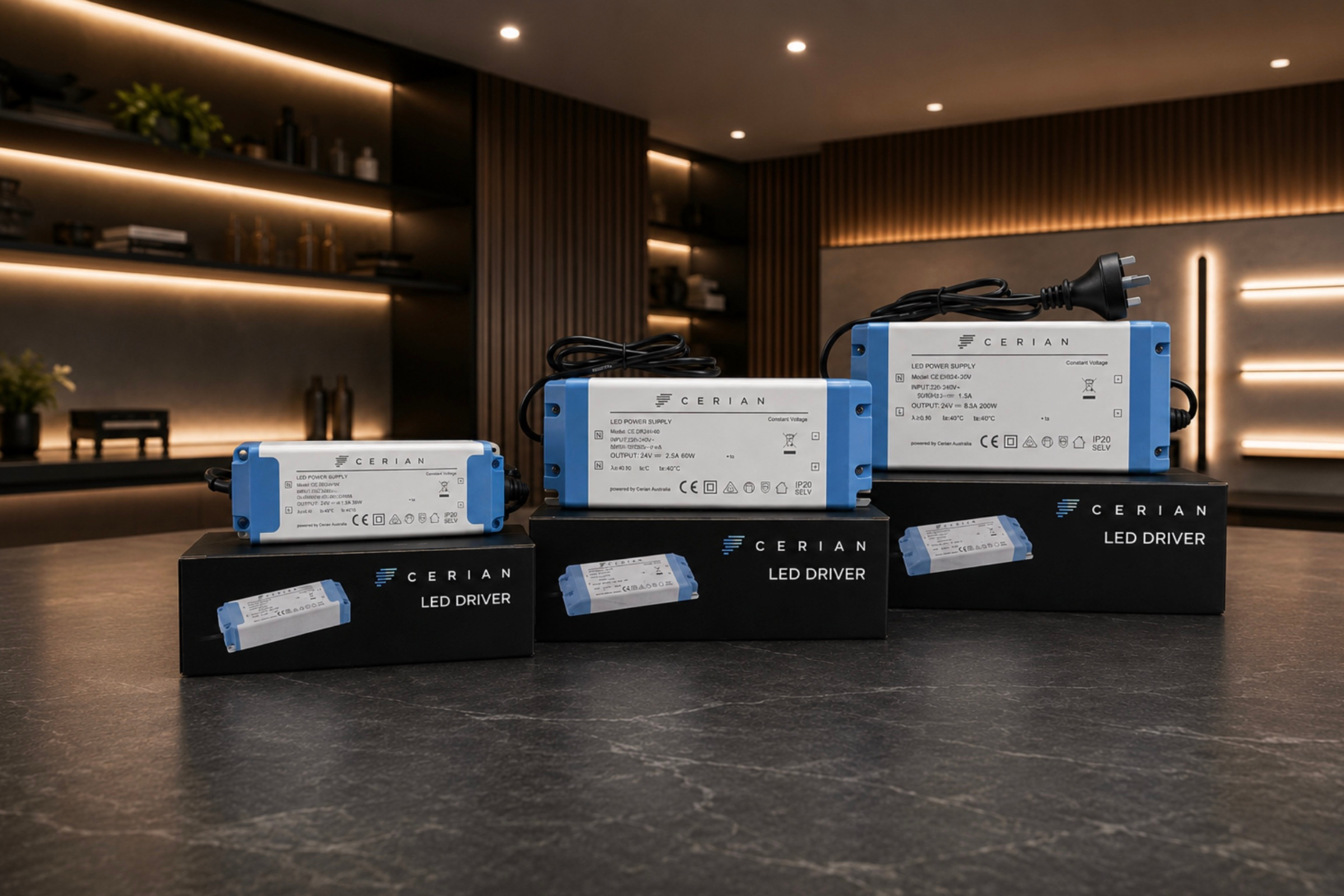
How to Choose a 24V LED Driver for LED Strip Lights in Australia
Match the driver to your LED strip
A 24V LED strip needs a compatible 24V DC power supply. Choosing the correct LED driver means checking output voltage, total wattage, available current, dimming requirements and installation conditions—not wattage alone. This guide explains the checks for residential, retail and commercial lighting projects.1. Confirm the required output voltage
Check the LED strip product label or datasheet. A 24V DC constant-voltage LED strip requires a suitable 24V DC constant-voltage driver. Do not connect a 12V strip to a 24V output. Constant-current LED fittings use different driver specifications and should not be assumed compatible.2. Calculate total strip wattage
Multiply the rated power per metre by the installed strip length: Total load (W) = strip power (W/m) × installed length (m) For example, a 4m run rated at 10W/m uses a nominal 40W. A 5m run rated at 15W/m uses 75W. These figures are illustrative: always use the specifications for the exact strip you purchase.3. Choose sufficient driver capacity
Select a driver rated above the calculated connected load, with an appropriate operating margin based on the manufacturer's instructions, ambient temperature and installation conditions. Do not exceed the driver's output rating. For a 24V driver, output current can be estimated by dividing watts by 24: a 100W 24V driver supplies approximately 4.17A at its rated output. Explore Empire of Light's LED drivers and power supplies, including the 36W, 60W, 100W, 150W, 200W and 320W categories.4. Check dimming and controller compatibility
A driver is not necessarily dimmable. Some constant-voltage systems use a compatible controller between a non-dimmable driver and the LED strip. Check the exact driver and controller specifications before ordering, especially for RGB, RGBW or colour-temperature-adjustable strips.5. Check IP rating and installation environment
Indoor, dry installations may use an appropriately specified IP20 driver. Damp, outdoor or exposed installations require suitable environmental protection for the entire system, including the power supply, connectors and cable terminations. A waterproof LED strip does not make an indoor-rated driver waterproof. Do not infer suitability for underwater use from the strip rating alone.6. Consider cable length, ventilation and electrical safety
Long low-voltage cable runs can introduce voltage drop and uneven brightness. Follow manufacturer limits for strip lengths, cable sizing, cooling and mounting. Fixed electrical work in Australia must be carried out by a licensed electrician in accordance with applicable requirements.Example: selecting a driver for a kitchen LED strip
Suppose your design uses 3m of 24V strip rated at 12W/m. The nominal load is 36W. A driver rated exactly 36W may leave no suitable operating margin, so compare larger compatible driver options and follow the product's recommended loading limits. Check the intended dimmer or controller before purchasing.Frequently asked questions
Can I use a higher-wattage LED driver?
Yes, provided the output voltage and driver type match the strip, the system is compatible and the driver's operating requirements are met. The strip draws power according to its design; a higher driver rating does not automatically force extra wattage into it.Can one driver power multiple LED strips?
Potentially, if the strips are compatible and the combined load, wiring and installation comply with the driver's specifications. Check current distribution and voltage drop.Do I need a waterproof driver for outdoor LED strips?
Use a driver and complete installation rated for their actual exposure. Indoor-rated power supplies must be installed in a suitably protected location where permitted by the manufacturer's instructions.Find compatible CERIAN lighting products
Browse LED strip lights in Sydney and CERIAN LED drivers at Empire of Light. Confirm each product's current datasheet and installation requirements before purchase.
10 Creative Ways To Use Smart Led Downlights For Stunning Interior Designs
Smart LED downlights revolutionise interior design, offering energy-efficient lighting solutions with customisable features. Whether you want to enhance ambience, improve functionality, or add a modern touch to your space, smart downlights provide endless possibilities. In this blog, we explore 10 creative ways to incorporate these innovative lighting solutions into your interior designs.
1. Layered Lighting for Depth and Ambiance
Combining smart LED downlights with ambient, task, and accent lighting creates a well-balanced interior design. Use dimmable LED downlights to adjust brightness levels and set the mood for different occasions.
2. Highlight Architectural Features
Illuminate unique design elements such as ceiling coves, archways, or textured walls with strategically-placed smart downlights. This technique enhances depth and adds a luxurious feel to your space.
3. Smart Downlights for Task Lighting
Smart LED downlights are perfect for kitchens, study rooms, and workspaces. Adjustable brightness and colour temperatures allow you to create an optimal environment for cooking, reading, or working tasks.
4. Dynamic Colour Temperature Adjustments
Choose warm white tones for a cosy atmosphere in bedrooms and living areas, or opt for cool white to boost office productivity. Smart downlights make it easy to switch between colour temperatures based on your needs.
5. Creating a Smart Home Experience
Integrate smart downlights with home automation systems like Google Home or Amazon Alexa for seamless control. Voice commands and app-based settings make lighting customisation effortless.
6. LED Down Lights for Accent Lighting
Use smart LED downlights to highlight artwork, sculptures, or decorative pieces. Accent lighting enhances focal points and creates a visually-appealing environment.
7. Customisable Scene Settings
Set up different lighting scenes for activities such as movie nights, dinner parties, or relaxation. With a smart lighting system, you can switch between presets to match the desired ambience.
8. Energy Efficiency and Sustainability
Smart LED downlights consume less power than traditional lighting solutions, helping you reduce energy costs while contributing to a greener environment. Their long lifespan also minimises replacement frequency.
9. Enhancing Bathroom and Vanity Lighting
Install moisture-resistant smart downlights in bathrooms to create a spa-like experience. Adjustable brightness ensures perfect lighting for grooming and relaxation.
10. Outdoor and Patio Lighting
Extend smart lighting to outdoor spaces like patios and balconies. Weather-resistant LED downlights can enhance outdoor aesthetics while providing functional lighting for nighttime activities.
Transform Your Space with Smart LED Downlights
Smart LED downlights are an essential element of modern interior designs. Their versatility, efficiency, and customisation options make them ideal for enhancing any space. Explore the latest lighting solutions and interior design ideas at Empire of Light and elevate your home’s ambience today! Contact Empire of Light for more information.
Top 5 Benefits Of Switching To LED Ceiling Lights In 2025
In 2025, lighting technology continues to advance, offering homeowners and businesses more efficient and stylish options. One of the best investments you can make for your space is upgrading to LED ceiling lights. Whether you're looking to enhance energy efficiency, improve aesthetics, or integrate smart LED lighting, making the switch to modern ceiling light fittings has never been more rewarding. Let’s explore the top five benefits of upgrading your ceiling lighting to ceiling LED lights this year.
1. Energy Efficiency and Cost Savings
One of the biggest advantages of LED ceiling lights is their energy efficiency. Traditional incandescent and fluorescent bulbs consume more electricity and generate excess heat, whereas ceiling LED lights use significantly less power to produce the same, if not better, illumination.
By switching to smart lights, you can further enhance efficiency through features like dimming, motion sensors, and automated schedules. This means you use only the energy you need, reducing wastage and cutting down on electricity bills. With energy prices on the rise, investing in smart LED lighting ensures long-term savings without compromising on brightness or quality.
2. Longer Lifespan and Durability
Unlike conventional bulbs that burn out quickly, LED ceiling lights have an impressively long lifespan. A high-quality LED smart light can last up to 50,000 hours, which means you won't need to replace your ceiling light fittings as often. In comparison, traditional incandescent bulbs last around 1,000 hours, and CFLs (compact fluorescent lights) last about 8,000 hours.
Additionally, ceiling LED lights are built with sturdy materials that withstand vibrations and external impacts better than delicate filament-based bulbs. This makes them ideal for both residential and commercial settings, ensuring reliability and reduced maintenance costs.
3. Smart Features and Enhanced Control
The evolution of smart LED lighting has transformed how we interact with illumination in our homes and workplaces, making lighting more intuitive, efficient, and customisable. Whether you're setting the perfect ambience for relaxation, enhancing focus in a workspace or engaged in any other activity, smart LED lighting provides a seamless and modern solution that adapts to your lifestyle and needs.
Some of the key smart features include:
-
Dimming options to create the perfect ambience
-
Colour-changing capabilities to suit different moods and settings
-
Motion sensors that turn lights on and off based on movement
-
Scheduling functions to automate your ceiling LED lights for energy savings
By incorporating smart LED lighting, you enhance convenience, security, and overall functionality while reducing unnecessary energy consumption.
4. Improved Aesthetics and Versatility
Gone are the days when ceiling light fittings were limited to basic, uninspiring designs. Today, LED ceiling lights come in a variety of styles, shapes, and finishes to complement any interior design theme. If you prefer sleek recessed ceiling lighting, modern pendant lights, or elegant chandeliers, there are ceiling LED lights to match your vision and budget.
Moreover, smart lights allow you to customise brightness levels and even adjust colour temperatures to create warm, neutral, or cool lighting effects. This versatility makes them perfect for every room in your home, from the kitchen and living room to bedrooms and bathrooms.
5. Eco-Friendly and Sustainable
In 2025, sustainability is a top priority for homeowners and businesses alike. Upgrading to LED ceiling lights is an environmentally-responsible choice because they:
-
Consume less electricity, reducing carbon footprints
-
Do not contain harmful substances like mercury, unlike CFL bulbs
-
Generate minimal heat, which lowers cooling costs in summer
-
Are recyclable, making disposal eco-friendly
By making the switch to ceiling LED lights, you contribute to a greener planet while enjoying modern, efficient, and stylish ceiling lighting solutions.
Why Switching to LED Ceiling Lights in 2025 is a Smart Choice
The benefits of switching to LED ceiling lights in 2025 are undeniable. From lower energy bills and longer lifespans to enhanced aesthetics and smart LED lighting capabilities, upgrading your ceiling light fittings is a smart move for any home or business. With technological advancements in smart lights, you gain better control, efficiency, and sustainability — all while creating the perfect ambience for your space.
Upgrade Your Ceiling Lighting Today for Long-Term Benefits
Beyond functionality, the switch to ceiling LED lights represents a shift toward a more sustainable and future-proof lighting solution. As energy regulations tighten and consumers become more conscious of their environmental impact, investing in ceiling lighting that is both efficient and stylish ensures you stay ahead of the curve. Additionally, with smart home integration becoming more common, the ability to control your smart LED lighting through voice commands, mobile apps, or automation adds a layer of convenience that was once considered futuristic.
By making the switch now, you not only improve your living and working environment but also future-proof your space with cutting-edge ceiling lighting technology.
If you're ready to embrace modern lighting solutions, investing in ceiling LED lights is the best decision you can make for 2025 and beyond.
Don’t wait — upgrade your ceiling light fittings today and experience the perfect blend of style, efficiency, and innovation! Contact the experts at Empire of Light today to find out more.
Top Features To Look For When Buying LED Strip Lights
The modern lighting revolution has established strip lights as the preferred lighting solution for homeowners as well as designers and business operations. Selecting the appropriate LED light strips is essential when you want to enhance your home's ambience, light up outdoor areas, or build a smart home experience. Given the vast range of choices available, how can you determine which LED strip light will work best for your requirements?
Follow this guide to learn about the top features of LED strip lighting which will help you make an educated purchase decision to enhance your space with style, efficiency, and durability.
1. Smart LED Light Intensity
The initial factor to evaluate during smart LED light strip selection involves its brightness level. The brightness level of a lighting application is determined by its lumen measurement. Moderate brightness levels of LED light strips work well for mood lighting in bedrooms and living areas. Under-cabinet kitchen lighting and workspaces require task lighting with higher lumen output.
Tip: Review the lumens per metre specification shown on the packaging to choose the right LED light strip. The best brightness level for creating a general ambience with smart LED light strips ranges between 150 and 250 lumens per metre, and task lighting requires a minimum of 400 lumens per metre
2. Colour Options and Customisation
Do you prefer a warm, cosy glow or a vibrant burst of colours? LED light strips come in different types, such as single-colour (warm white, cool white, or daylight) and RGB (Red, Green, Blue) options. Advanced versions, like RGBW and RGBCCT, allow for even more customisation by incorporating white light variations for a balanced effect.
Best for:
-
Warm white: Cosy bedrooms and lounges
-
Cool white: Office spaces and task areas
-
RGB: Party and gaming setups
-
RGBW: Versatile spaces that need both white and colour options
3. Smart Control and Connectivity
A modern smart LED light strip should be compatible with smart home ecosystems like Alexa, Google Home, or Apple HomeKit with Wi-Fi or Bluetooth connectivity; you can control brightness, colours, and scheduling through a mobile app or voice commands.
Why This Matters:
-
Remote control from anywhere.
-
Set automation schedules (eg: dimming at night, brightening in the morning
) -
Sync with music, movies, and gaming setups for an immersive experience
4. Waterproof and Outdoor Durability
If you’re looking for LED outdoor lighting strips, it's essential to check the waterproof rating. LED strip lights are rated using the IP (Ingress Protection) scale. For instance:
-
IP20: Indoor use only (eg: behind TVs, under cabinets)
-
IP65: Water-resistant, suitable for outdoor covered areas
-
IP67/IP68: Fully waterproof, ideal for gardens, patios, and pools
Pro Tip: Choose high-quality LED outdoor lighting strips with weatherproof coatings to ensure longevity in all conditions.
5. Energy Efficiency and Lifespan
One of the greatest advantages of LED light strips is their energy efficiency. Unlike traditional lighting, LEDs consume significantly less power while offering impressive brightness. Look for options with a long lifespan (typically 30,000–50,000 hours) to ensure you get the most value for your investment.
Cost Savings:
-
Lower electricity bills
-
Reduced replacement costs
-
Eco-friendly, with minimal heat emission
6. Length and Cuttable Options
Before purchasing, measure the space where you want to install your strip lighting. Many LED strip lights come in fixed lengths (eg: 5m or 10m), but the best ones offer cuttable sections so you can tailor them to fit your space perfectly.
Installation Flexibility:
-
Cut to size for customised applications
-
Extendable options available for larger areas
-
Adhesive backing for easy installation
7. Dimming and Flicker-Free Performance
Some LED light strips offer dimmable features, allowing you to adjust brightness levels for different moods and needs. However, not all strips support dimming unless paired with a compatible LED dimmer or a smart controller.
Look for:
-
Flicker-free technology to reduce eye strain
-
Compatibility with dimmers and smart controls
-
Smooth dimming without sudden brightness drops
8. Adhesive Strength and Installation Ease
Nothing is more frustrating than an LED light strip that peels off after a few days. High-quality strip lighting comes with strong 3M adhesive backing or mounting clips for added support.
Installation Tips:
-
Clean the surface before sticking the strip
-
Use mounting clips for better security, especially for outdoor use
-
Opt for a plug-and-play design to avoid complex wiring
9. Heat Dissipation and Safety
Safety is a key concern when installing LED light strips, especially in enclosed spaces. Premium LED strips are designed with heat-dissipating materials, preventing overheating and ensuring a longer lifespan.
Check For:
-
Low-heat emission for safety
-
UL certification or equivalent safety ratings
-
Proper ventilation in enclosed installations
10. Price Vs Quality Balance
While it might be tempting to opt for the cheapest option, high-quality smart LED light strip solutions provide better brightness, durability, and efficiency. Investing in a trusted brand ensures longer-lasting performance, fewer replacements, and overall better user experience.
Final Verdict:
-
Prioritise brands with high customer reviews
-
Compare warranties (1-year minimum recommended)
-
Look for well-built components for long-term use
Choosing the Right LED Strip Light for Your Needs
With so many choices in the market, selecting the perfect strip light can feel overwhelming. But by focusing on the key features of brightness, colour options, smart control, durability, energy efficiency, and installation ease, you can find the ideal solution for your space.
If you're looking for high-quality LED lighting solutions, look no further than Empire of Light. As an Australian-based company specialising in both residential and commercial lighting, we offer premium LED outdoor lighting strips, smart LED light strips, and advanced strip lighting options designed for durability and performance. Explore our vast collection today and transform your space with innovative lighting solutions!
How To Choose The Perfect LED Strip Lights For Your Home And Office
Lighting has the power to transform any space, setting the mood and enhancing both functionality and aesthetics. Whether you're looking to create a cosy ambience in your living room, add task lighting to your kitchen, or modernise your office workspace, LED strip lights for home and office offer the perfect solution. If you're searching for LED lighting in Sydney, you'll find a variety of options to suit your needs, ensuring both style and efficiency.
But with so many choices available, how do you select the best LED strip lights for your space? This guide will walk you through the essential factors to consider, from LED strip light installation to choosing the right type for your specific environment. By the end, you'll be equipped with all the knowledge to make an informed decision, ensuring a seamless blend of aesthetics, energy efficiency, and durability.
LED Strip Lights For Home
Before beginning the process of choosing LED strip lights, you should understand why these lights have become so popular for home and office use in Australia.
-
Energy Efficiency: LED strip lights use much less electricity than traditional lighting solutions and help lower your energy expenses.
-
Long Lifespan: LED strips offer a long life of up to 50,000 hours, unlike incandescent bulbs that have a shorter lifespan.
-
Versatility: Customisable LED strips provide the perfect lighting solution for bedrooms needing soft warmth or workspaces requiring bright task lighting.
-
Easy Installation: LED strips are equipped with adhesive backing which enables effortless installation of LED strip lights.
-
Customisable Options: LED strips give you the ability to adjust lighting designs through dimmable options and RGB colour-changing effects to suit your personal preferences.
Now that we understand the advantages of LED strip lights, we can select the most suitable options for your home and office spaces.
Understanding LED Strip Lights Types
Selecting LED strip lights types begins with learning about the various LED strip light types available in the market. Different types of LED strips are designed for specific functions so selecting the right one for your space becomes essential.
1. Single-Colour LED Strips
These strips provide consistent light output in fixed colours which include options like warm white, cool white, daylight, and various other colors. Their fixed colour output makes single-colour LED strips the perfect choice for basic lighting needs in homes and offices that require one uniform light shade.
2. RGB (Red, Green, Blue) LED Strips
RGB strips enable colour changes and dynamic lighting effects to be achieved. Accent lighting and entertainment spaces like home theatres and gaming rooms benefit greatly from these lights.
3. RGBW (Red, Green, Blue, White) LED Strips
RGBW LED Strips function as a superior model of RGB strips that include an extra white LED to enable both full-colour displays and white light output. These strips function well in spaces that need both colourful and neutral light options.
4. Smart LED Strips
Smart LED strip lights contain Wi-Fi or Bluetooth connectivity that lets you manage them through smartphone apps or voice commands and remote controls. Tech-savvy users who want automated lighting solutions will find these LED strips perfect for their needs.
5. High-Density LED Strips
These strips contain more LEDs in each meter which results in brighter and more evenly distributed light. These lighting options work perfectly in office spaces and kitchens as well as any other task-based environment.
The intended application of lighting determines which type of LED strip lights you should choose. LED strips offer a dual function where RGB strips serve mood lighting, and high-density or single-colour strips meet task lighting needs.
Brightness and Colour Temperature
The brightness level, when quantified in lumens, needs to correspond to the intended use of the room. Ambient lighting needs 300-600 lumens per metre, but task lighting requires between 800-1200 lumens per metre.
Colour temperature is another key aspect:
-
Warm white LED lights with temperatures between 2700K-3000K create a cosy atmosphere, making them ideal for bedrooms and lounges.
-
Cool White lighting between 4000K-5000K creates a modern atmosphere that works well in kitchens and bathrooms.
-
Daylight colour temperature ranges from 6000K to 6500K and provides bright and energetic lighting perfect for workspaces.
How to Choose Optimal LED Strip Lights for Office Spaces
Office lighting that is properly implemented increases productivity while reducing eye fatigue and establishing a professional environment. Consider these factors when selecting LED strip lights for office environments:
1. Brightness and Efficiency
Effective office performance depends on environments that are sufficiently illuminated. Choose LED strips that provide high brightness levels of 800 to 1200 lumens for each metre of length.
2. Colour Temperature
-
Lighting with a cool white temperature (4000K-5000K) enhances focus while diminishing tiredness.
-
Conference rooms require intense focus and perform best under daylight colour temperatures between 6000K and 6500K.
3. Flicker-Free Technology
Select LED strips with flicker-free technology to prevent eye strain and headaches during extensive work periods.
4. Professional Aesthetics
Recessed LED strips provide an elegant and contemporary appearance by disappearing into office design. Smart LED strips allow for the creation of dynamic work environments.
LED Strip Lights Installation
The straightforward installation process makes LED strips a popular choice for many applications. Here’s a simple step-by-step guide:
Step 1: Measure and Cut the Strips
Determine the necessary length of the LED strips before cutting them at their designated points.
Step 2: Prepare the Surface
Proper adhesion requires the installation surface to be cleaned and dried before placing the LED strips.
Step 3: Attach the LED Strips
Remove the adhesive backing from the strip before pressing it securely onto the installation surface.
Step 4: Connect to a Power Source
The LED strip needs to be connected to an appropriate power adapter and controller when required.
Step 5: Test and Adjust
Illuminate the area using the lights and examine their brightness distribution. Adjust the settings as needed.
To achieve a professional look, use aluminium channels that will house LED strips and deliver a sleek, polished appearance.
The best places to purchase LED strip lights throughout Australia can be found where quality and service meet to provide excellent lighting solutions, like Empire of Light.
Final Thoughts
To select the best LED strip lights, you need to evaluate several factors, including the type of LED strip lights as well as their brightness levels, colour temperature and installation needs. LED strip lights provide an adaptable and energy-saving lighting solution for both home ambience enhancement and office productivity improvement.
Purchasing premium LED strips from Empire of Light ensures durable performance along with excellent aesthetics and customised lighting solutions for your space. Illuminate your area right now and discover how LED lighting can revolutionise your space!

COB Linear Lighting LED Strip
COB Linear Lighting the market demand for LED light source performance gradually increases, the pursuit of high quality, high luminous efficacy, high cost performance, the emergence of flip-chip COB light source appropriately meets this kind of market demand.
COB LED strip is a kind of LED flex strip that the flip-chip is directly fixed on the flex FPC, which directly encapsulates flip-chip as lighting application with different color and color temperature without the bracket and gold wire needed for LED encapsulation.
The combination of SMT technology and LED encapsulation technology is conducive to realize full automation and high efficiency of production line.

welded on FPC
The chip is directly welded on FPC, which has low thermal resistance and good heat dissipation, without the influence of the silver plating layer of the bracket, and the problems of vulcanization and oxidation are solved.
Without the gold wire, the product will not be affected by the damp, high temperature, and the risk of the dead LED bead caused by broken gold wire, so as to achieve high reliability, high life of the product.
Flip-chip COB light source is one of the development trends in the next few years.
Cerian is manufacturer complete COB full-automatic production line, Cerian has absolute lead in COB product research and development, quality control and production process for australian market.
COB linear lighting LED strip production line of Cerian is rich in combination, we can provide customized services. Specific features of the product as follow:
-
High CRI, uniform luminance.
-
Warranty of 3-5 years or 130-22, 000 hours.
-
Flip chip encapsulation, low attenuation, good heat dissipation, long life.
-
Linear lighting without light spot, good consistency.
-
Anti vulcanization.
-
Can be used with linear fixture profile with arbitrary height.
-
Wide beam angle, up to 140°.

linear lighting LED strips from Cerian positioning in high-end, with high CRI of 90.
Warranty of 3-5 years. With recommended width of 8mm and 10mm, recommended color temperature of 3000K, 4000K, 6500K, voltage of 24V.
There are optional quantity of 320 LEDs, 512 LEDs, 720 LEDs per meter in our products. Due to its unique technical advantages, COB linear lighting LED strips can be widely used in commercial lighting, linear lighting and high-end display lighting,
Such as the main lighting or decorative lighting in hotel, shopping mall, chain stores, home and other places.
Advantages Of COB Flexible Strip light
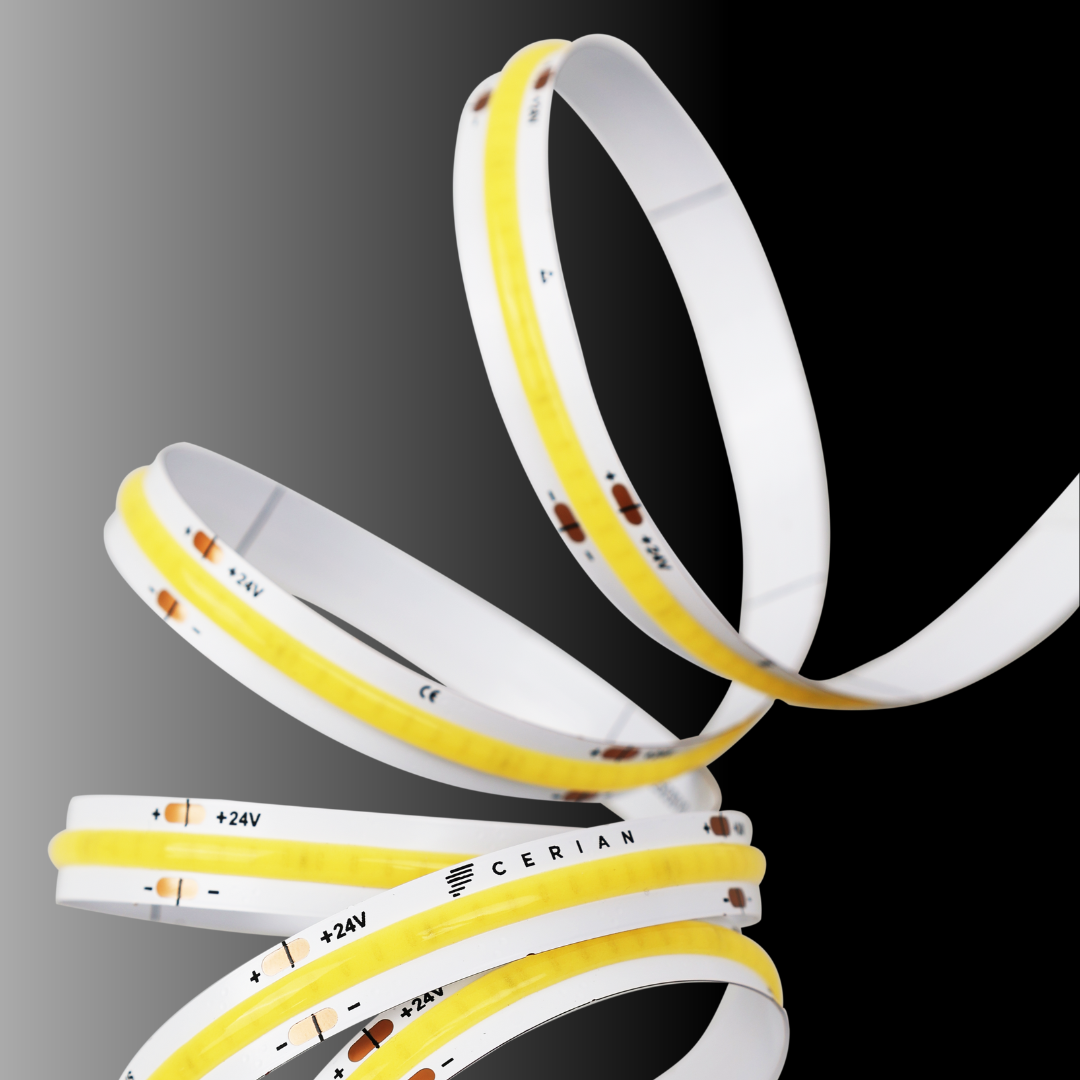
With the gradual maturity of LED COB Flexible Strip light technology, users have higher and higher requirements for the stability and reliability of LED lighting products. Under the same conditions, it is even more required that products can achieve better energy efficiency, lower energy consumption, and more competitive product prices. Based on market demand, COB lighting products have emerged, becoming a hot product in the LED lighting application market and are favoured by users and designers. Compared with the SMD patch packaging of conventional LED light strips, COB light strips are flexible light strips that directly solidify the inverted chips on flexible FPCs, eliminating the brackets and gold wires required for LED packaging, and directly encapsulating them into lighting applications of different colours and temperatures.
Advantages COB Flexible Light Belt Products
Because the COB light strip is directly welded to the FPC flexible board, the substrate directly dissipates heat, which can reduce the advantages of good heat resistance and heat dissipation; the influence of the silver plating layer without bracket solves problems such as vulcanisation and oxidation, and can also reduce the production process and cost; without gold wire, the product will not be pulled under high temperature after moisture. Breaking the gold wire causes the risk of dead lights, thus achieving high reliability and long life. With the continuous maturity of COB light belt production technology and the continuous improvement of the supporting industrial chain, the performance of COB light belt is stable and reliable, which will stand out in the huge LED lighting market and become one of the future development trends of LED lighting.
Comparison between COB flexible light strip product structure and conventional light strip
Cerian has been deeply engaged in the LED lighting subdivision industry for more than 5 years, and has always adhered to innovative technology and updated products. It has a strong R&D team, a number of authoritative authorised laboratories and basic application laboratories to ensure quality and quality.
-
Linear luminescence, uniform continuity, no light spots; wider application range, stronger adaptability, better effect.
-
The linear light source has a large light angle of up to 140 °, and the luminous surface angle can reach 180 °.
-
It adopts COB inversion process, which is anti-vulcanisation and antioxidation.
-
High-profile finger, CRI 90, high colour consistency, softer luminous surface.
-
The substrate directly dissipates heat, with low thermal resistance, better heat dissipation efficiency, less light attenuation and longer service life.
-
The product line series is rich, including monochrome, two-colour and RGB series, which can be matched with various thickness profiles at will and apply various scenarios; cooperate with various controllers to achieve various intelligent effects.
Cerain COB flexible light belt products are positioned at the middle and high end, with high display fingers, CRI≥90, mainly promoting 8 mm and 10mm widths, with 320 lamps, 512 lamps and 720 lamps per metre. The colour temperature is complete and there are rich categories, except for the main colour temperature of 2700K, 3000K, 4000K, In addition to 6500K, there are also red, green, blue monochrome light, two-colour temperature, RGB and other categories. Because of its unique technical advantages, COB light belt products can be widely used in commercial lighting, linear lighting and mid-to-high-end prop display lighting, such as main lighting or decorative lighting in hotels, shopping malls, supermarket chains, homes and other places.
As we all know, commercial places have high requirements for lighting products, such as display, illumination, colour temperature, lighting effect, etc., and COB light sources meet the above needs well because of their unique technical advantages. The COB lamp belt is linearly luminous, continuous and uniform, which solves the spot problem well and caters to the application needs of key lighting in commercial places. Due to the long-term use of lighting products in commercial places, the heat dissipation capacity of lighting products is relatively high, while COB light belt products have direct heat dissipation, with low thermal resistance and better heat dissipation efficiency.
Linear lighting plays an important visual guidance role in space, has hinting significance in modelling, and leads people's attention to the route of space design. COB light strips have the advantages of linear luminescence, continuous uniformity, no light spots and high colour consistency. With simple types of materials, various fashionable and simple shapes and light and shadow effects can be built, highlighting the ultimate beauty of linear lighting! The COB light source has high index, high light efficiency, and stable product performance, which has become a linear lighting source favoured by designers.
The lighting of display props such as window exhibition cabinets should not only have aesthetics, but also carry out visual enhancement of goods and set off the atmosphere. Therefore, when designing decorative lighting, the lighting should be clearly structured and expressive; at the same time, average and single brightness should be avoided. In addition, with different commodity displays, lighting should pay attention to the coordination of colour temperature. The sunrise COB light belt has linear luminescence, uniform continuity, no shadow, and the COB light source has high finger display and high lighting efficiency. It can match various profiles to meet the needs of various scenes and realise various display prop lighting applications. It can be matched with various control systems to realise scene intelligence.
According to the application environment space, reference material and design style, the COB light belt product category can be selected accordingly. Monochrome temperature, two-colour temperature, RGB, etc. can be selected for different scene needs, or the control system can be matched to achieve diversified dynamic lighting effects and scene intelligent control. Generally, warm colours are often used in homes, hotels, entertainment and leisure spaces, and slightly cold colours are often used for sunpox wall dark slots in office and commercial spaces.
Before installing the lamp belt, please clean the installation surface of the structural dark groove or profile to keep the installation surface clean without dust or dirt, so as not to affect the paste of the light belt.
During installation, sharp and sharp hard objects or high-temperature objects should be avoided from triggering the surface of the colloid in the light area, so as not to damage the colloidal body, causing bad results and affecting the luminous effect.
When installing the light strip, the length of the lamp belt needed to be installed should be measured on the spot. When it needs to be cropped, the extra light strip should be cut along the COB lamp strip welding pad labelling line. If you need to add connecting wires, please weld them at the welding pad mark at the shearing place.
When pasting the light strip, remove the edge of the shape paper on the back and paste it. It is strictly forbidden to tear off all the release paper at a time to avoid sticking to each other.
When installing the light strip, pay attention to the contact between the cutting and incision of the light strip and the bottom of the profile to avoid short circuit. When installing the light belt around the corner, it is strictly forbidden to fold it into right angles, and it is strictly forbidden to bend directly on the profile metre.
The light strip is generally powered by DC12V / 24V (DC). When choosing a power source driver, choose the right power supply according to the length of the lamp strip that needs to be installed. The total power of the light strip driven by each power supply should be less than 80% of the rated power supply.
After the light strip is installed, the light strip conductor is connected to the power output end. Do a good job in insulation, anti-short circuit and anti-corrosion treatment at the terminal and end.
Improve The Accuracy Of The Led Flux Testing In The Sphere
According to the particularity of LED luminous flux measurement, unique optimization is adopted in the design of the integrating sphere for LED measurement combined with the diffuse materials of high reflectivity, which makes the system stability and accuracy have great improvement. The experimental results show that the system stability and consistency is much higher than other common LED test system. It is the system which is really suitable for LED optical parameters measurement.
Different with the traditional light source, the luminous flux measurement of LED light source has posed a big challenge to the equipment in testing the veracity in the process of using the integrating sphere to test luminous flux. On one hand, compared with the traditional light source, usually, LED has much stronger directivity, and will not shine evenly in whole space. This feature makes the distribution of LED direct light in the surface of the integrating sphere uneven
This uneven distribution will cause the direct light of different LED has different reflection features of the detector. Because the position of the detector mouth and the position of the baffle are fixed, the direct performance of various reflection distributions is signal fluctuation. In the ordinary testing system, there exist the differences in LED of different positive divergence angle, the same LED of different placed direction, the same direction with different position. Even the rated luminous flux is the same; the actual measured value is different. Based on the customer’s verification result, the effect of LED placed direction of ordinary LED test system on the luminous flux measurement result is always more than 50 % (the difference of the maximum signal and minimum signal of the same LED measured in different direction).

Different lighting angle has different effect on LED measurement
When measuring the different lighting angle of different LEDs, since the distribution difference of the surface of the inside integrating sphere makes the distribution of the direct reflection have different effect on the detector, it directly affects the difference of the accuracy of the measurement
he inside reflection characteristic of the integrating sphere is one of the crucial factors that make the LED directivity have the impact on the measurement accuracy. In the ordinary LED test system, the reflectivity and the Lambert character of the integrating sphere surface coating are not ideal. One reason is the low reflectivity, and the other reason is the poor diffuse characteristics. The result of the integrating sphere surface of low reflectivity is that the direct light of LED gradually attenuates after few times of reflection. However, during the whole process of mixing light, the direct irradiation light and reflection light have held a very large proportion, which has made a leading role. And in some conditions, low reflectivity materials will cause strong shadow effect on the back of the baffle probe. However, it is the straight reflected light and shadow effect that leads to the inaccurate measurement.
Moreover, lower diffuse reflectivity will seriously affect the attenuation of the signal. Since the light has been reflected for many times in the integrating sphere during the process of the light measurement, each reflection will cause certain attenuation, but the impact of the reflectivity degree on the light intensity has been strengthened after many-times reflection. For example, the reflected light has been reflected for 15 times in the integrating sphere, if there is 5% difference between their reflectivity, the signal attenuation may exceed more than doubled. Actually, the reflectivity difference in the integrating sphere is far more than this.
The current LED test system has not been used as the standard LED for the standard light source. In the process of measurement, we still choose to use the standard halogen tungsten lamp with stable driver as the standard light source. Since there is a big difference in the external structure between the standard lamp and the measuring LED, including the light absorption effect of LED holder and the difference between the standard lamp installation position and LED installation position, all these are the important factors that affect the accuracy of the test result.

Colour Temperature
The colour temperature a light source is the temperature of an ideal black-body radiator that radiates light of a colour comparable to that of the light source. Colour temperature is a characteristic of visible light that has important applications in lighting, photography, videography, publishing, manufacturing, astrophysics, horticulture, and other fields. In practice, colour temperature is meaningful only for light sources that do in fact correspond somewhat closely to the radiation of some black body, light in a range going from red to orange to yellow to white to blueish white; it does not make sense to speak of the colour temperature of, a green or a purple light. Colour temperature is conventionally expressed in kelvins, using the symbol K, a unit of measure for absolute temperature.
Colour temperatures over 5000 K are called "cool colours" (bluish), while lower colour temperatures (2700–3000 K) are called "warm colours" (yellowish). "Warm" in this context is an analogy to radiated heat flux of traditional incandescent lighting rather than temperature. The spectral peak of warm-coloured light is closer to infrared, and most natural warm-coloured light sources emit significant infrared radiation. The fact that "warm" lighting in this sense actually has a "cooler" colour temperature often leads to confusion.
The CIE 1931 chromaticity space, also showing the chromaticity of black-body light sources of various temperatures, and lines of constant correlated colour temperature.
The colour temperature of a light source is the temperature of an ideal black-body radiator that radiates

How To Choose Your Lighting
Importance of choosing the right lighting for your home: Selecting the proper lighting for your home from the best Australian lighting supplier is crucial. This is because the light is the key contributor to the ambience of your home you want to set. Lighting allows you to appreciate the overall setting of a room fully. Proper lighting is vital to portray a well-designed and inviting atmosphere.
If you feel overwhelmed to choose lights for your house with the so many options available, don't worry. Here we have provided an ultimate lights online Australia to choose light fixtures for your home.
Starting with the RCM mark, this signals that the product has been tested to all relevant Australian Safety Standards and EMC, to ensure the product delivers its designed safety performance. In addition, when thermal insulation batts are installed in the ceiling cavity, look out for the IC rating label to ensure the product is suitable for such an application. All of CERIAN products are registered and match Australian standards
Retail shopping is all about the LOOK.
So, when asked for a recommendation for the general consumer commercial lighting, Empire of Light immediate choice for your lighting products such as: Frameless downlight, adjustable hole cut-out 70-205mm, 180 beam angles, tri-colour, Lifud constant current driver, aluminium +03 PC
We supply only the latest architectural quality LED lighting both nationally and internationally from our warehouse in Bonnyrigg. quality products and accessories in our state warehouse. We encourage you to inspect our quality LED lights
LED downlights are the perfect long lasting lighting solution because they provide you as a homeowner with many benefits. Using these lights, you can get a longer lasting energy solution the light-emitting diode (LED). The reason why LED lighting is so much more efficient is because you will save money using this form of lighting. LED lights do not emit the same amount of energy as what traditional fluorescent lighting does. How would you like to save a little money on your power bill this year, and every year after that?
That is what is at stake here. Not only is LED lighting a more efficient solution for your power consumption but it still provides a great amount of light just as a fluorescent light would. If that is not enough to convince you of the benefits of this form of lighting then consider that there is also less maintenance with them. They do not need replacing as often as fluorescent lights so that means less work for you.
LED CERIAN downlights also look great. The great thing about these lights is that they have the flexibility of changing their appearance. They can do more than just literally brighten up any room within your home because they also look great too. They have that aesthetic look that is perfect for a variety of higher-end Australian architectural markets. Here at Empire of light, we are the experts for a wide range of LED lighting solutions. We firmly believe that LED’s are going to be the way of the future when it comes to superior lighting. In fact, there are many benefits that you get from using LED’s compared to other lighting. See all the benefits of LEDs here

Understanding Colour Rendering Index (Cri)
CRI is the measurement of light in relation to how the lighting affects the appearance of colour in the surrounding area. The range has a direct correlation to the ‘temperature’ of a light also it’s effect on everything around it.

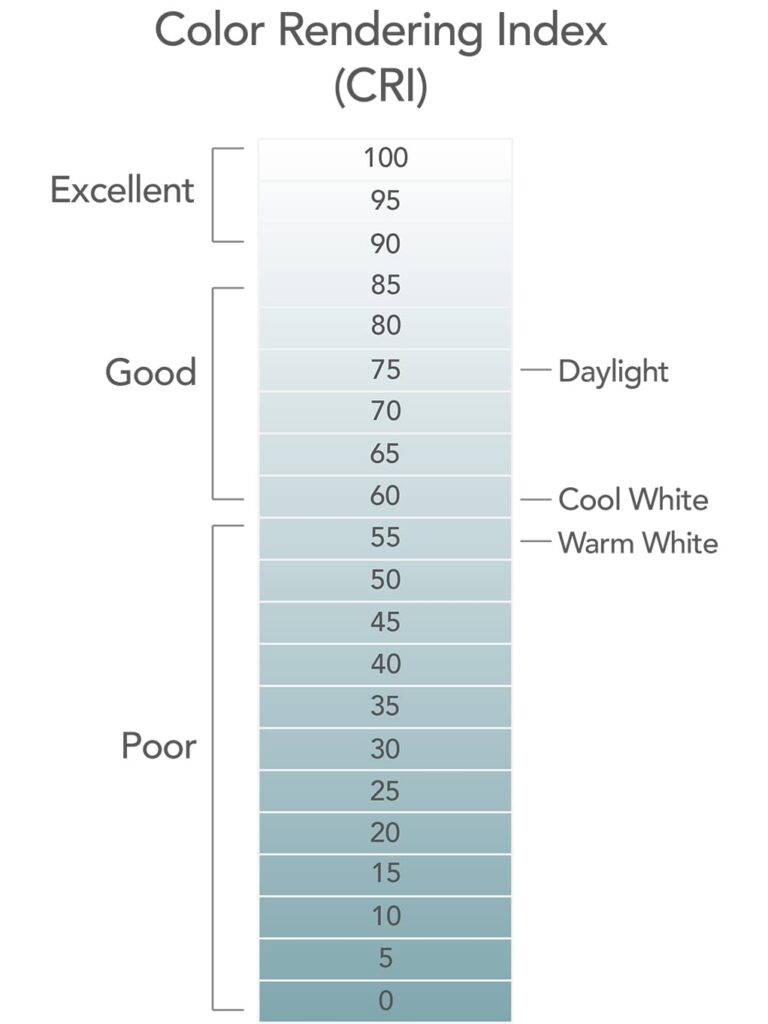
The Colour Rendering Index Lighting
The type of light bulb you use in your home could have a profound effect on the way a room looks. This is often attributed to something known as the colour rendering index. Also referred to as CRI, this index measures the ability of a light source to reveal colours of objects in contrast to a natural light source, such as the sun filtering in through your windows.
This range can also depend on the "temperature" of the light. For example, lighting temperatures can range from infrared light to the kind coming from a skylight, all the way to ultraviolet light. Ideally, you want to use lighting that will best illuminate each room depending on your needs.
Understanding the Colour Rendering Index Chart
Every type of lighting has its place on what's known as the colour rendering index chart. This chart measures a scale from 0 to 100, depending on how accurately it can produce light that matches a naturally referenced light source, such as the sun.
In general, bulbs at the higher end of the scale will produce a more accurate colour rendering of the objects around it. This can be vital for use in things like photography or lighting used in a museum setting. But it can also affect you and your home. It's best to choose bulbs that will make your surroundings clear, bright, and as close to how they would appear in an outdoor, natural setting.

Smart Lighting Control
Once you’ve experienced even a taste of what smart lighting can do, you’ll never look back. Besides the endless lighting opportunities it gives you (with up to 60 million colour options in one globe!), it also makes life so much easier and has a huge effect on your general health and well-being by allowing you to switch up the mood of a room to complement your activities.
CERIAN New way of our lighting future - control, you can control your Smart Home Lighting with your phone by WiFi or Bluetooth via an app. lights with one click. Or using voice control via Alexa, google home, and Siri. Discover the magic of transforming an entire room. and when you are home, choose the right light setting to help you concentrate better or relax after a tough day. It's time be smart with your lighting and upgrade your home to smart LED lights today!
Our lighting specialists have put together a list of their recommendations that are easy to use, and easy to install. After all, the whole point of smart lighting is convenience, which is why our team is available to answer any questions you may have about it. We recommend starting with the basics:
-
Discover a whole range of CERIAN lighting.
-
Replace your existing downlight with smart downlight that’s offer special light for every room in your home.
-
CERIAN downlights are easy and simple to install. It only takes a few minutes to set up and you don't have to rewire your home. You can change of 16 million colour + cool white + warm white also you can add motion sensors, switches for more options of control.
Our expert Sales Team, have excellent technical knowledge of our products and are experts in product application recommendations including; control system integration, dimming, RGBW, and DMX Dali interfacing.