

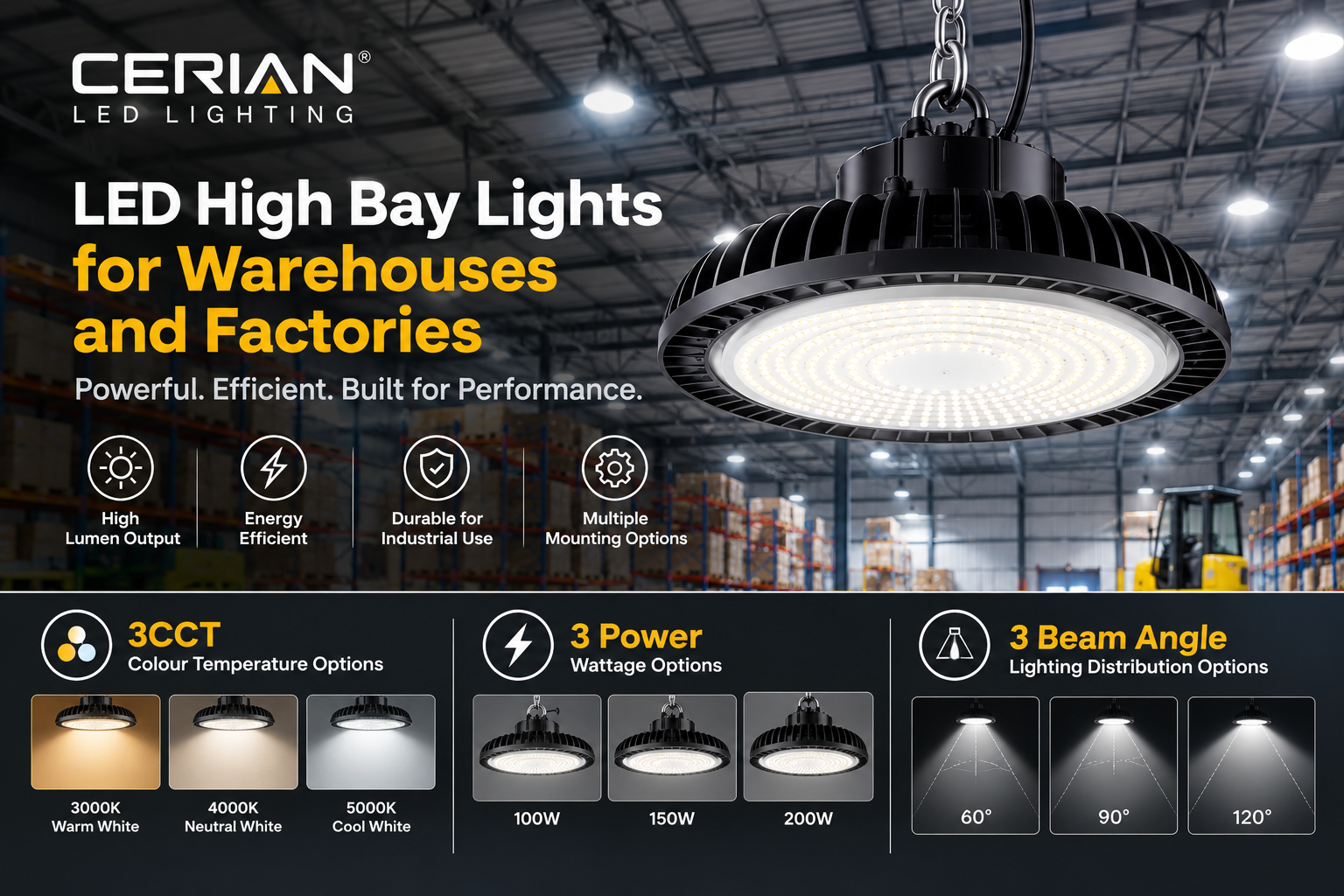
Choosing LED high bay lights for a warehouse, factory or distribution centre involves more than selecting a wattage. Mounting height, beam distribution, work tasks, racking layout and operating hours all affect the result. This guide explains the key checks for Australian commercial lighting projects.
What is an LED high bay light?
LED high bay luminaires are designed to illuminate spaces with relatively high ceilings, such as warehouses, manufacturing facilities, workshops and logistics centres. Different fittings use different optical distributions and mounting systems. Suitability must be determined from the actual luminaire datasheet and the project’s lighting design.
1. Start with the space and mounting height
Record the ceiling height, intended mounting height, floor area, racking positions, workstations and any obstructions. A fitting suitable for a wide open storage area may not be appropriate between tall warehouse racks. Mounting height influences the light distribution and spacing required for even coverage.
2. Compare lumens, not watts alone
Wattage indicates electrical power consumption, while lumens indicate the light output of the fitting. Two high bays with the same wattage can deliver different lumen outputs and optical performance. Compare manufacturer-rated lumens, luminaire efficacy in lumens per watt (lm/W), beam distribution and any relevant photometric files.
Example: A hypothetical 150W luminaire rated at 150 lm/W would deliver approximately 22,500 lumens. This is a calculation example, not a verified specification for any particular CERIAN product.
3. Choose an appropriate beam angle
Narrower beam distributions can concentrate light over a smaller area; wider distributions can spread light more broadly. The correct selection depends on mounting height, fixture spacing, aisle width, rack height and required uniformity. A lighting calculation using the manufacturer’s photometric data is more reliable than choosing beam angle from a simple height chart.
4. Plan the required illuminance
Different tasks require different lighting conditions. General storage, order picking, packing, machinery operation and detailed inspection should not automatically use the same lighting design. Consider task illuminance, uniformity, glare, vertical illumination and applicable workplace lighting requirements. An appropriately qualified lighting designer can check the design against relevant Australian standards and project requirements.
5. Select colour temperature and colour rendering
Neutral or cool white lighting is often considered for industrial spaces, but the correct colour temperature depends on the work environment and existing lighting. Colour rendering can be important where workers distinguish product labels, wire colours or material finishes. Review the documented CCT and CRI rather than assuming all high bays offer the same options.
6. Check glare and visual comfort
High output does not automatically mean good visibility. Excessive glare, harsh reflections and uneven lighting can make work more difficult. Consider mounting position, optical control and the viewing direction of forklift operators and other staff.
7. Review the operating environment
Factories and warehouses may expose luminaires to dust, moisture, elevated temperatures, vibration or cleaning processes. Check the specific luminaire’s ingress protection, ambient operating temperature, mounting requirements and any applicable impact resistance. For food processing or specialist environments, additional product suitability requirements may apply.
8. Consider controls and energy use
Occupancy sensors, daylight controls and scheduled switching may help reduce operating hours where suitable. Confirm the driver and luminaire support the proposed control method. A dimmable luminaire should not be assumed compatible with every dimming system.
For a simple energy estimate, a 150W fitting operating 10 hours a day consumes 1.5 kWh per day before accounting for control strategies. Multiply the number of fittings and operating days to estimate site consumption. Actual savings depend on the existing installation, new fitting performance and usage.
9. Check installation and maintenance access
Verify mounting hardware, suspension height, cable routing, emergency lighting interactions and access for future maintenance. Electrical installation in Australia must be undertaken by appropriately licensed professionals in accordance with applicable requirements. Confirm product documentation, warranties and any relevant compliance information before ordering.
LED high bay selection checklist
- Measure mounting height, floor dimensions and racking layout.
- Identify tasks and target lighting conditions.
- Compare verified lumen output, efficacy and photometric distribution.
- Check CCT, CRI, glare and uniformity.
- Confirm environmental ratings and operating temperatures.
- Review controls, electrical compatibility and maintenance access.
- Obtain a lighting calculation for larger or complex projects.
Frequently asked questions
Is a 150W LED high bay suitable for every warehouse?
No. Wattage alone cannot establish suitability. Mounting height, output, optics, fixture spacing and required lighting levels all matter.
How many LED high bay lights do I need?
The number depends on the room dimensions, mounting height, required illuminance, luminaire photometry, reflectances and obstructions. Use a lighting design rather than estimating from wattage alone.
Are LED high bays suitable for factories?
Many are designed for industrial applications, but check the exact product’s temperature limits, ingress protection, optics and any task-specific requirements.
Can high bay lights be dimmed or connected to sensors?
Some models support compatible controls. Check the actual driver’s capabilities and the specified control interface before installation.
Explore commercial LED lighting at Empire of Light
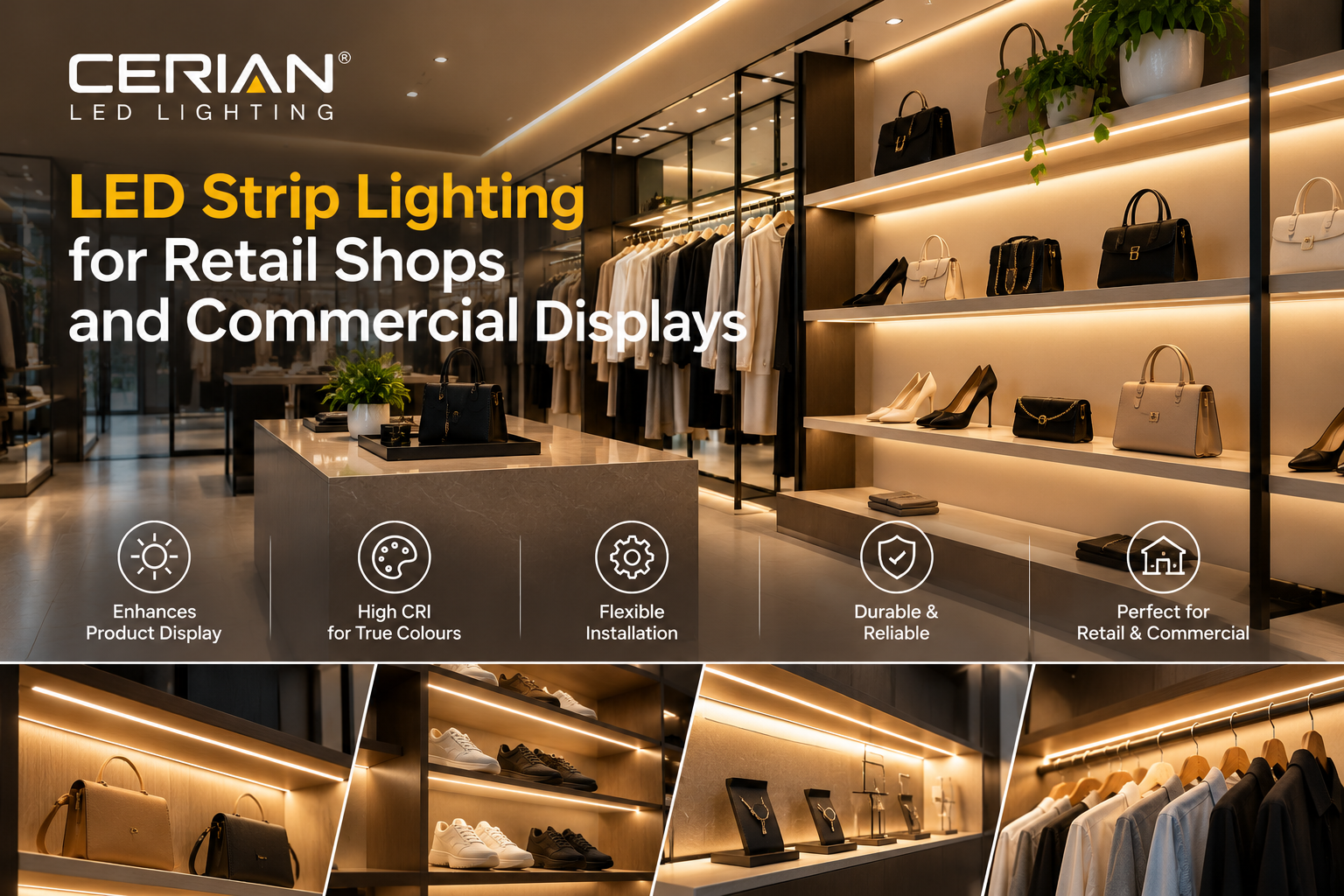
Empire of Light supplies lighting products for commercial and industrial projects in Australia. Browse the Empire of Light website for the current CERIAN range and request product-specific technical information when planning a warehouse or factory installation. For other commercial lighting applications, read our retail and commercial display lighting guide.