

When installing LED strip lighting, you often need to join two sections, connect a strip to a cable or turn a corner. Two common methods are using compatible LED strip connectors and making a soldered joint. Neither is automatically best for every installation: reliability depends on the strip design, connector quality, workmanship and environment.
LED strip connectors: how they work
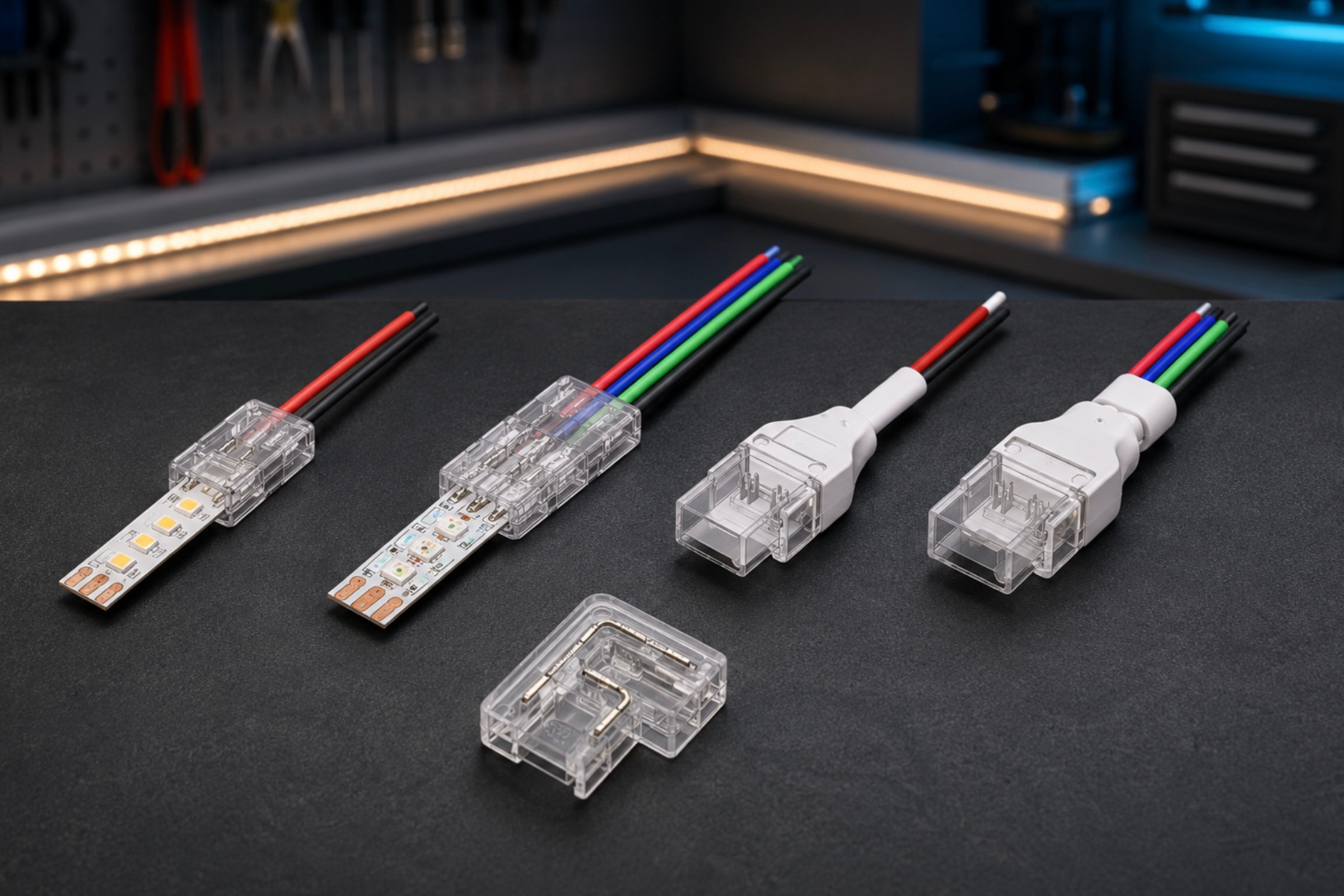
Many LED strip connectors clamp onto designated copper contact pads, allowing a connection without soldering. Options include strip-to-strip, cable-to-strip and corner connectors. Compatibility is critical: match the connector to the strip’s width, contact layout, pin count, coating and manufacturer’s specifications. COB strips may need connectors designed specifically for COB products.
Advantages of solderless connectors
- Fast installation for compatible LED strips.
- Useful for testing, maintenance and some accessible installations.
- Can simplify corners or joins without specialist soldering equipment.
Limitations include connector bulk, possible poor contact if fitted incorrectly, and incompatibility with some coated or high-density strips. A connector described as waterproof does not automatically make the completed joint suitable for every wet location.
Soldered LED strip connections
Soldering attaches appropriately sized conductors to suitable contact pads. When performed correctly on a strip approved for soldering, it can create a compact connection, particularly in tight profiles. However, soldering requires appropriate tools, technique, strain relief and insulation. Excess heat can damage the strip or pads, and a poorly made joint may fail over time.
Connectors vs soldering: comparison
| Factor | Solderless connectors | Soldering |
|---|---|---|
| Installation | Usually faster on compatible strips | Requires tools and soldering skill |
| Physical size | Connector housing may be bulky | Can be compact with suitable insulation |
| Maintenance | Some connectors are removable | Typically requires rework to change |
| Reliability | Depends on fit, contact and environment | Depends on workmanship and strain relief |
| Water protection | Requires verified compatible sealing system | Requires verified restoration of sealing after joining |
Which connector do you need?
2-pin connectors for single-colour strips
Many single-colour LED strips use two electrical contacts, but check the actual strip before selecting a 2-pin connector. Width and pad geometry must also match.
4-pin connectors for certain RGB strips
Some RGB strips use four contacts. Other colour-changing systems can use different pin counts or control methods, so do not assume every RGB, RGBW or RGB+CCT strip uses the same connector.
COB LED strip connectors
COB strips have dense light-emitting surfaces and may have different cut points or contact arrangements from conventional LED tape. Choose connectors explicitly compatible with the exact COB strip model and width.
Corner and cable-to-strip connections
Corner connectors can help route lighting around furniture or cabinetry. Cable-to-strip connectors are useful when the power supply or controller is located away from the strip. Check polarity and conductor capacity for the connected load.
Important checks before making a join
- Switch off power: never connect or cut a powered LED strip.
- Check the cut point: cut only where the manufacturer permits.
- Match voltage and contacts: verify 12V/24V compatibility, pin layout, strip width and polarity.
- Check electrical load: ensure the connector and wiring are rated for the expected current.
- Protect the joint: provide strain relief, insulation and suitable environmental sealing.
- Test before closing the profile: check consistent brightness and stable operation.
What about outdoor and waterproof LED strips?
Cutting an IP-rated strip or adding a join may affect the original ingress protection. Follow the strip and connector manufacturers’ approved sealing instructions. An IP67 strip or connector alone does not prove the entire assembled system is IP67. For further guidance, read IP20 vs IP67 vs IP68 LED Strip Lights.
Do connectors cause voltage drop?
Every connection has some resistance. Poor contact, undersized wiring or excessive run length can contribute to voltage drop, heat or flicker. Follow manufacturer limits and investigate unusual heating or intermittent operation rather than assuming a connector is suitable because it physically fits.
Frequently asked questions
Are solderless LED strip connectors reliable?
They can be reliable when approved for the exact strip and installed correctly. Poor fit, incorrect contact alignment or moisture exposure can cause problems.
Can I use a regular LED strip connector on a COB strip?
Not necessarily. Check that the connector is designed for the COB strip’s width, pad arrangement and coating.
Is soldering always stronger than a connector?
No. A well-designed connector may outperform a poorly soldered joint. Both methods require appropriate strain relief and environmental protection.
Can I reconnect an IP67 strip after cutting it?
Only where the manufacturer permits cutting and provides an approved method to restore the required protection.
Explore CERIAN LED strip lighting
Browse Empire of Light’s LED strip light range and LED drivers. For power supply sizing, see how to choose a 24V LED driver. Check each connector’s product specifications before purchase to confirm it suits your strip.